The first six months of 2025 raised fears about the potential impacts of natural catastrophes. However, since tropical storms in the North Atlantic avoided making landfall in the United States, 2025 ultimately became the least expensive year for economic losses since 2015, according to Aon.
Greg Case, CEO of Aon, noted that even though economic losses were lower in 2025, “the long-term trend is clear: Weather exposures are rising,” he wrote in the introduction to the 2026 Climate and Catastrophe Insight report, released on January 20.
This volatility within a single year—and from one year to the next—should not obscure the broader reality, says Jérôme Jean Haegeli, Chief Economist at Swiss Re: “Insured losses keep rising,” he stated in the reinsurer’s December summary.
Haegeli added that the insurance and reinsurance industries have a dual mandate: to absorb the shocks from these events and to properly inform public policymakers and private investors about the actions needed to mitigate future damages.
“Sheer luck spared the United States from hurricane landfalls in 2025,” said Thomas Blunck, a member of Munich Re’s board of management, in a statement released January 13, 2026. However, he noted that the U.S. market remains the most expensive for insurers due to a growing trend of large losses from secondary perils.
According to the Swiss Re Institute, insured losses from catastrophic events totalled US$107 billion in 2025, a slight drop of 3 per cent compared to the 10-year annual average. In contrast, total economic losses reached US$220 billion, down 18 per cent from the 2015–2024 average. All figures below are in U.S. dollars.
Aon identified 49 events with economic losses exceeding US$1 billion, 30 of which also surpassed that threshold in insured losses. Were it not for the Los Angeles wildfires, 2025 would have been the least costly year for insured losses in the past decade.
Hurricanes and typhoons
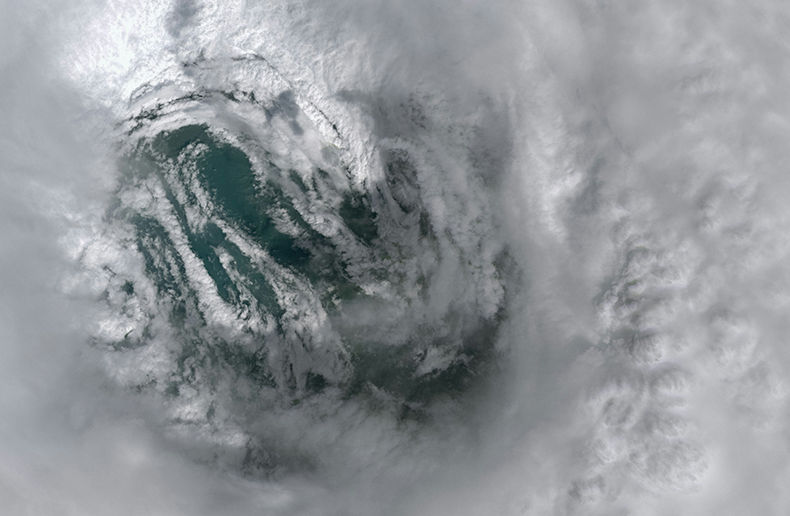
Although the 2025 North Atlantic hurricane season was fairly active—with 13 tropical storms, including three Category 5 hurricanes on the Saffir-Simpson scale—not one of the five hurricanes made landfall in the U.S., a first in 10 years, according to Munich Re.
Hurricane Melissa, which devastated Jamaica and Cuba on October 22 and 23, resulted in US$2.5 billion in insured losses, according to Swiss Re. Munich Re pegged the overall losses across all affected countries at US$9.8 billion, including US$3 billion in insured damages, and at least 95 fatalities.
Aon highlighted a record-breaking wind gust from Hurricane Melissa, reaching 402 km/h at 200 metres above sea level—the strongest ever recorded by a probe. The report also praised the National Hurricane Center’s AI algorithms, which enabled authorities to be alerted three days before Melissa struck Jamaica. Gallagher Re also devoted a section of its report to the use of AI for predicting hurricane paths and destructive potential.
In Southeast Asia, torrential rains and tropical storms in November caused major flooding, especially in Vietnam, Thailand and Indonesia. Munich Re stated that typhoons Senyar and Ditwah claimed at least 1,750 lives. Gallagher Re reported at least 2,129 fatalities from these two events, while Aon estimated 2,049 storm-related deaths.
Gallagher Re noted that the reinsurance industry began 2026 with record capital levels, estimated at US$838 billion. Among the trends the firm will monitor this year is the need to update building codes—or introduce them where none exist—to limit damage in large urban areas. The reinsurer also reported on modest progress at COP 30, held in Brazil, and stressed the importance of securing concrete commitments to keep global warming within the 1.5 °C limit set in the Paris Agreement.
California burns
Depending on the source, between 80 and 83 per cent of global insured losses in 2025 came from U.S. claims. In a December 16 report, Swiss Re researchers stated that wildfires in the Los Angeles metro area in January alone resulted in more than US$40 billion in insured losses. Munich Re reported the same estimate, while Aon and Gallagher Re each assessed the losses at US$41 billion.
Regarding these fires—the costliest in recent memory—Swiss Re stated: “The scale of destruction reflects a convergence of meteorological drivers, such as extended hot, dry conditions and strong winds, with greater exposure—especially for high-value residential assets expanding into hazardous wildland-urban interface (WUI) zones.”
Howden Re’s 2025 Natural Catastrophe Snapshot made a similar observation, citing the mix of long-term drought and violent winds. This weather cocktail occurred in developed areas near WUI, triggering two exceptionally severe events due to high exposure and vulnerability to fire.
Howden Re also pointed to the low proportion of California claimants who obtained rebuilding permits since the January 2025 fires. “Delays reflect homeowners’ uncertainty about committing to a lengthy reconstruction process, particularly for high-value properties that require custom materials, scarce skilled labour and complex permitting. These challenges can be seen even today in the ongoing reconstruction from the Tubbs and the Camp fires of 2017 and 2018 respectively,” the report said.
Heatwaves
Aon reported roughly 42,000 global deaths in 2025 from natural catastrophes and extreme weather. This includes approximately 24,400 heat-related deaths across Europe during several heatwaves from June to August.
Gallagher Re reported a similar estimate of 24,000 deaths in Europe, along with at least 282 in Japan, Korea and the U.S. The extreme heat, along with related droughts and fires, caused widespread damage in Spain, Italy, France, Belgium, Germany and the United Kingdom, Aon noted.
Severe convective storms
Severe convective storms (SCS) continue to account for a significant portion of insured losses—US$50 billion in 2025, according to Swiss Re. “Urbanization in hazard-prone areas, rising asset values, higher construction costs and factors such as ageing roofs have made these storms a key peril for insurers,” said Balz Grollimund, Swiss Re’s Head Cat Perils.
“As single events rarely result in a large insured loss, it is key for insurers to consider the cumulative effect of frequent, low-loss events, along with increasing property values and repair costs. A more holistic view of this peril is critical to assure proper underwriting and risk management,” Grollimund added.
Aon reported total insured losses from SCS at US$61 billion, while Gallagher Re estimated these storms accounted for US$60 billion, or 47 per cent of all insured losses.
Howden Re highlighted the exceptional nature of Typhoon Ragasa, which caused major damage in Southeast Asia—especially in Hong Kong and Taiwan—from September 21 to 26. Storm surge warnings ranging from 3.5 to 3.8 metres were issued along Hong Kong’s eastern shores, but peak surges did not coincide with high tide, reducing flood severity in vulnerable areas.
Given the region’s population density and concentration of assets, a major typhoon could cause record-breaking losses. “Historical analysis shows no clear trend in severe typhoon frequency affecting Hong Kong, underscoring the growing importance of risk modelling and financial resilience,” Howden Re stated.
Earthquakes
The magnitude 7.7 earthquake in Myanmar on March 28, 2025, caused at least 4,500 deaths, according to Munich Re, and losses estimated at US$12 billion, including US$1.5 billion in insured damages. Aon placed the economic toll at US$15.7 billion and reported 5,456 deaths. Gallagher Re estimated US$14.5 billion in losses and 4,663 fatalities.
Howden Re reported 5,300 deaths from the Myanmar quake, which ruptured 500 kilometres of the Sagaing fault. The tremor was felt as far away as Bangkok, Thailand—over 1,000 kilometres from the epicentre—where an under-construction residential tower collapsed.
The earthquake (and aftershocks) that hit Kunar, Afghanistan, from August 31 to September 5 was the second-deadliest disaster of the year, with around 3,000 deaths reported by Munich Re and Aon. Gallagher Re estimated 2,217 fatalities.
Swiss Re highlighted the effectiveness of the Pacific early warning system, which was activated in July after a magnitude 8.8 earthquake struck Russia’s Kamchatka Peninsula—the sixth-largest quake of its kind since 1900. The quake generated a tsunami with waves felt in Hawaii and along the U.S. West Coast, but the early alert system helped save lives, the reinsurer said.