
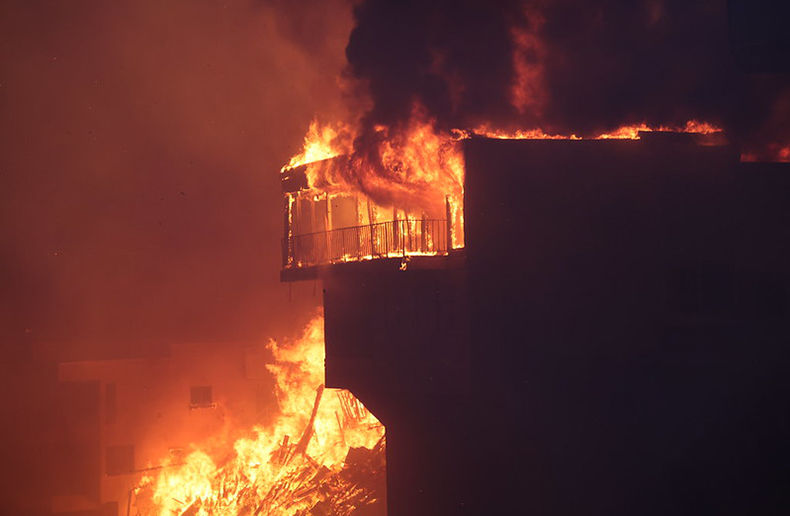
The devastating wildfires that tore through several counties in the Los Angeles region in January 2025, and the earthquake in Myanmar at the end of March, marked the first half of 2025.
According to recent reports published by various reinsurers and brokerage firms, insured losses related to natural catastrophes worldwide have already exceeded USD 100 billion, which is well above the average since 2000, according to Aon. (All figures below are in US dollars.)
Munich Re notes that insured losses for the first half of 2025 rank second since the reinsurer began documenting these events in 1980. The worst year was 2011, due to the earthquake and tsunami in Japan. Researchers from the Swiss Re Institute reached the same conclusion.
Gallagher Re estimates there were 21 events that caused economic losses of over USD 1 billion—the lowest total since 2015, when 19 such events were reported.
Swiss Re, for its part, estimates insured losses at USD 80 billion for the first half of 2025.
Aon reports 26 disasters that caused economic losses of more than USD 1 billion in the first half of the year.
California in flames
From January 7 to 28, wildfires in Pacific Palisades and Eaton counties in California caused approximately 30 deaths and economic losses totaling USD 57 billion, according to Aon.
Gallagher Re reports economic losses of USD 65 billion for these two events, including USD 40 billion in insured damages.
Munich Re’s estimate, published on July 29, stands at USD 53 billion for the same wildfires in the greater Los Angeles area, including USD 40 billion in insured losses.
Tobias Grimm, Munich Re’s Chief Climate Scientist, explains the unusual nature of January’s fires in California: “Santa Ana winds are common in California during winter. At the same time, the wildfire season tends to last longer than in the past because there is often less precipitation in the cooler months.”
“This means that two accelerants— drought and strong winds —coincide more frequently. Then all it takes is just one spark in the wrong place for disaster to strike,” he adds.
Swiss Re also estimates USD 40 billion in insured losses linked to the January 2025 fires in California. “Wildfire is a complicated peril for the insurance industry to model. Human actions influence the occurrence and damage potential of wildfires to a much greater extent than other perils,” state the authors of the semiannual report.
“Traditional risk evaluation methods – such as predictive or probabilistic models – have been largely insufficient in assessing evolving wildfire threats,failing to account for the complex interactions between drivers of wildfire risk, changes in fire behaviour and interannual variability. Wildfire remains a volatile peril and in our view, more and rising associated insured losses can be expected,” add the researchers at the Swiss Re Institute.
Fatalities
According to Aon’s mid-July report, the number of fatalities from these events was significantly below average, with 7,700 deaths. The average since the beginning of the 21st century is 37,250 deaths.
More than 72 per cent of these deaths occurred following the earthquake that struck Myanmar (formerly Burma) on March 28, where 5,456 people lost their lives. Economic losses from this event are estimated at USD 11.9 billion, again according to Aon.
Munich Re’s economic loss estimate is similar at USD 12 billion, but it notes that a very small percentage is insured. However, the reinsurer reports a lower human toll, at 4,500 deaths. Swiss Re estimates 3,900 fatalities and economic losses exceeding USD 14 billion. It says it is unable to provide a precise figure for insured damages.
According to Munich Re, the earthquake reached a magnitude of 7.7. The epicentre was near Sagaing and Mandalay, where about one million people live. The Sagaing fault runs north to south across the country. The tremor was felt more than 1,000 kilometres away in Bangkok, Thailand.
Gallagher Re reports economic losses of USD 14 billion related to this event in Myanmar, including USD 1.3 billion in insured losses. Its estimate of the death toll is similar to Munich Re’s, at 4,521 deaths.
Major disasters
In an appendix to its report, Gallagher Re breaks down events by type: drought, earthquake, European windstorms, floods or landslides, severe convective storms, tropical cyclones, wildfires, or winter storms. To be included, an event must have caused at least USD 100 million in economic losses or resulted in 10 or more deaths.
At the very end of the list appears the “other” category, which includes the heatwave that struck Europe starting June 24, notably affecting the United Kingdom, France, Italy, Spain, Germany, Portugal, Hungary, and Croatia. As of July 3, Gallagher Re had already reported 2,308 deaths linked to extreme heat.
By adding up figures from these 151 major disasters, Insurance Portal counts 8,696 deaths linked to natural catastrophes. The figures come from Gallagher Re, which did not provide a total.
Melting glacier
Aon’s report highlights an event that underscores the impact of climate change: the collapse of a glacier on Mount Bietschhorn that completely submerged the village of Blatten, in the canton of Valais, Switzerland, on May 28.
Approximately 130 buildings in the village were buried, not including homes flooded by the lake formed when the Lonza River was split in two. Fortunately, the 300 residents of Blatten had been evacuated on May 19. The body of one victim was found on June 24.
Swiss insurers estimate insured losses at over CHF 320 million (USD 400 million), making this the 11th most expensive event in history. The volume of glaciers in the Swiss Alps shrank by 38 per cent between 2000 and 2024. As of July 4, 2025, the previous winter’s snow and ice had already melted, contributing further to the thinning of the glaciers ahead of winter 2026.
Hurricane season
In July, experts at Colorado State University (CSU), a partner institution of the Gallagher Research Center, forecast a season of 16 tropical storms in the Atlantic basin, of which 8 are expected to become hurricanes.
Three of those hurricanes were projected to be major (Category 3 or higher). CSU estimated a 51 per cent chance that one of those major hurricanes would make landfall in the continental United States.
A first major hurricane, Category 4 on the Saffir-Simpson scale, has been skimming the southeastern US coast since August 18. In its early days over the Atlantic, Hurricane Erin caused at least nine deaths in Cape Verde due to flooding and landslides, according to Aon. Roughly 200 mm of rain hit the island nation on August 10 and 11.
20 years since Katrina
Gallagher Re’s report also revisits 2005, when four major hurricanes struck the United States, including Katrina, which flooded 80 per cent of New Orleans, Louisiana. Adjusted to 2025 dollars, total economic losses reached USD 298.4 billion, including USD 145.9 billion in insured losses from Atlantic hurricanes.
Approximately 1.5 million people were evacuated following Katrina’s path through Alabama, Mississippi, and Louisiana. It was the largest population displacement due to a weather event since the Dust Bowl storms that hit the Midwest in the 1930s. About 40 per cent of those displaced by Katrina never returned home.
According to the reinsurer, the impacts of the 2005 hurricanes—following an already active 2004 tropical storm season—dramatically changed how insurers perceive climate-related catastrophe risk. Policy wordings were entirely revised.
Some US states have since updated their building codes to make homes more hurricane-resilient. However, according to the Insurance Institute of Business Home Safety, Texas, Alabama, Mississippi, and Georgia need to follow the lead of Louisiana, Florida, South Carolina, and Virginia by updating their homebuilding regulations.
The Swiss Re Institute also published a sigma report on the 20th anniversary of Hurricane Katrina, calling it a “turning point” for the insurance industry. The population of the New Orleans metropolitan area remains 20 per cent below its 2005 level.
Swiss Re’s loss estimate is lower than Gallagher’s. In 2024 dollars, Swiss Re puts the economic losses at USD 225 billion and insured losses at USD 105 billion. Approximately USD 26 billion in claims were paid by the National Flood Insurance Program (NFIP), the public program operated by the Federal Emergency Management Agency (FEMA).
Private insurers, for their part, paid USD 79 billion in claims, in 2024 dollars, according to Swiss Re Institute researchers. That represented roughly 11.3 per cent of the entire US property and casualty industry’s capital that year—a record share. Of that total, about USD 13 billion was paid out in oil rig platform claims.