
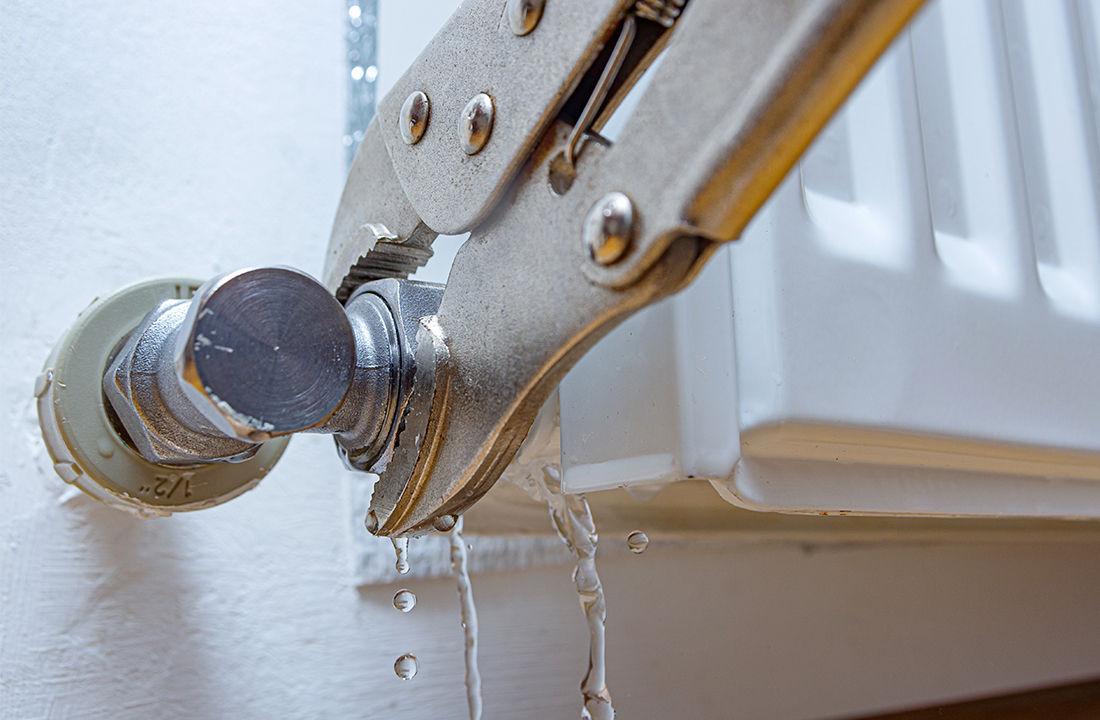
Water damage accounts for nearly half of all home insurance claims in Quebec, according to the Insurance Bureau of Canada (IBC). Although often unpredictable, these claims can be prevented or mitigated thanks to new technologies. Insurers and policyholders share the savings generated by preventing these claims.
While leak detection systems for water outlets have existed for many years, recent technology has led to the development of flow meters that detect variations in water consumption in real time.

The new systems, connected to the home's main water valve and a mobile app, allow homeowners to remotely shut off the main valve if an unusual water flow is detected. Some smart systems also automatically shut off the valve, particularly when no one is detected on the property, explains Jean-Hugues LaBrèque, president of the Water Damage Prevention Association of Canada (PREVCAN).
“These technologies reduce the risk of leaks and water damage to almost zero,” he explained in an interview with the Insurance Portal. “If you just install leak detectors that go off, there’s no preventative measure.”
PREVCAN aims to ensure quality and compliance standards for devices and their installation to prevent disasters. Five manufacturers and several dozen installers are members; for this reason, product accreditation is carried out by an external engineering firm.
Tests conducted by PREVCAN since its founding in 2017 have analyzed the effectiveness of the devices. In a sample of 5,000 residences, with a total history of water damage claims of $31.8 million, 7,740 leaks were reported after 28,137 detectors were installed. No claims were filed with an insurer, LaBrèque stated in an email following his interview with the Insurance Portal.
A shift in attitude
“The way things have long been done in the insurance industry has been to negotiate a contract, collect the premium, and compensate the client when a claim is filed for which the damages were covered,” explained Jerry Fairborn, National Sales Manager, Commercial for Moen Canada, a manufacturer of smart leak detectors, in an interview.
“With technological advancements, we can now anticipate and prevent such claims, which helps protect homes,” Fairborn added.
Nine insurers—Intact, Wawanesa, Northbridge, Desjardins, Promutuel, Aviva, TD Insurance, and more recently, Citelle Mutuelle—are also members of PREVCAN.
“Water consumption itself doesn’t affect insurers, but since flow meters can detect leaks and shut off the valve, there’s a preventative benefit for them,” says Jean-Hugues LaBrèque.
A quick return on investment
He adds that some insurers now require the installation of a minimum number of leak detectors per supervised water outlet (often five) to grant a premium discount. “They therefore don’t recognize individual detectors purchased at big-box stores,” he explains.
Depending on the model, a leak detection device costs between $650 and $800, says LaBrèque. Installation adds between $300 and $500 to the total bill.
This investment can quickly pay for itself, however, as insurers offer discounts of up to 10 or 15% on the annual premium to policyholders who have taken this preventative step. “Insurers are increasingly recognizing the value and effectiveness of professional protection that is properly installed and monitored over time, and this translates into more structured benefits for policyholders,” he points out.
This is particularly true for Promutuel and Desjardins (10%), but also for The Personal and Co-operators, to name just a few.
“The key element is the automatic shut-off of the water valve because the system can operate even when residents are away,” said Sébastien Caron, Director of Corporate Underwriting at Desjardins. “In the event of a claim, the deductible can now range from $500 to $1,000. This represents significant savings for policyholders.” “
Beneva also offers discounts to individuals who install smart detectors, the insurer confirmed by email.
“The effect on the premium depends on the building's profile and its overall risk level. It should also be noted that these types of water damage are not among the most frequent claims, which explains why the discounts generally remain modest and tailored to the specific context of each building. For example, they do not apply to claims where the water originates from outside the building,” the email stated.
Adoption is slowly gaining ground
For now, the adoption rate of the system remains low in single-family homes, but it is attracting interest from owners of multi-unit buildings, says Jean-Hugues LaBrèque.
“The initial buyers of these systems have high-rise buildings,” he explains. “You can imagine that a leaking toilet on the 9th floor could cause damage to those below. That would represent thousands of dollars in potential claims.”
“In condominium associations, these solutions are being promoted to keep insurance as affordable as possible while reducing risks.” They help limit damage caused by water leaks inside buildings, but they target a very specific risk category,” Beneva’s media relations department stated in an email.
PREVCAN indicates that it works in conjunction with the Régie du bâtiment du Québec (RBQ), among others, in its mission to educate and prevent water damage.
According to LaBrèque, discussions are underway to make the installation of smart motorized valves mandatory in new construction to facilitate shutoff in the event of a leak, among other things.
“This is a proposal currently under review for the next edition of Chapter III – Plumbing of the Québec Construction Code,” confirmed an RBQ communications officer in an email to the Insurance Portal.