
Following 2024 during which the number of claims from natural disasters was considerable in Canada, 2025 was relatively calm. Yet 2025 still ranks tenth among the costliest years in terms of insured losses related to catastrophe claims.
According to the estimate reported by the Insurance Bureau of Canada (IBC) on January 20, severe weather events resulted in insured losses of 2.4 billion dollars (B$) in 2025.
In 2024, Canada experienced its worst year with major losses causing more than $9B in insured losses. In the table below, it is clear that eight of the 10 costliest years for insurers in this regard have occurred in the last decade.
For 2025, Catastrophe Indices and Quantification (CatIQ), reported five weather events that represented 53 per cent of the amounts paid for such claims. These notable events are listed in order of importance:
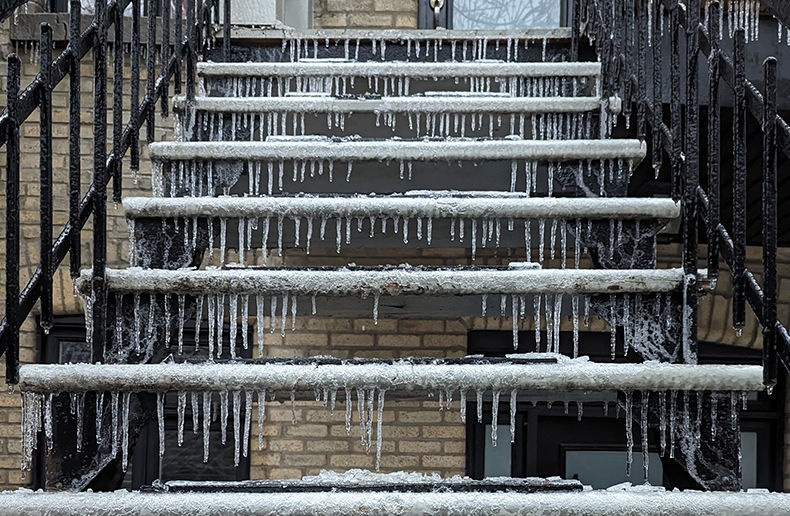
- the ice storm from March 28 to 31 that hit Ontario and Quebec: $490 million ;
- the wildfires in Flin Flon (Manitoba) and La Ronge (Saskatchewan) in May: $300 million ;
- the severe storms of August 20 and 21 in the three Prairie provinces: $235 million ;
- another hail storm in Calgary on July 13: $160 million. In this regard, the IBC notes that insured damages related to hailstorms have exceeded $6 billion over the past five years ;
- the series of atmospheric rivers that caused flooding in British Columbia in December: $90 million. Regarding this subject, the IBC mentioned in mid-December that many of the properties damaged in 2025 were no longer insurable due to their vulnerability, which was exposed during the 2021 floods.
From 2006 to 2015, insured losses caused by severe weather events amounted to $14 billion after adjusting for inflation. Over the last 10 years, these damages have reached $37 billion, an increase of 164 per cent over the previous decade, the IBC indicates. The number of claims paid related to these events has nearly doubled over the same period.
Considering the need to build new housing, the IBC urges all levels of government to invest in community resilience. The organization specifically mentions adopting land-use rules that ensure new construction is not built in floodplains.
2025, the third‑hottest year
On January 14, the World Meteorological Organization (WMO) reported that the average global surface temperature last year exceeded the 1850–1900 average by 1.44 °C. In doing so, 2025 is one of the three hottest years ever observed.
The last three years, the WMO adds, have been the hottest ever recorded. The consolidated three‑year average temperature for the period 2023–2025 is 1.48 °C higher than the pre‑industrial era. The margin of error is 0.13 °C.
The 2015–2025 trend confirms this warming trend. According to Celeste Saulo, secretary‑general of the organization, despite the La Niña current that induces cooling, the accumulation of greenhouse gases (GHGs) in the atmosphere continues to trap heat. “High land and oceans temperatures helped fuel extreme weather—heatwaves, heavy rainfall, and intense tropical cyclones, underlining the vital need for early warning systems,” Saulo says.
The oceans absorb about 90 per cent of the excess heat due to climate warming. The average annual sea surface temperature globally was 0.49 °C above the reference period 1981–2010.
The WMO analyzes eight data sets to make these estimates, and the providers communicated their findings on the same day. Two of these providers ranked 2025 as the second‑hottest year.
According to data reported by the European Center for Medium Range Weather Forecasts Copernicus Climate Change Service, one of the WMO’s providers, the average temperature was 14.97 °C in 2025. All monthly average temperature records have been recorded over the past three years, researchers note.
Meeting commitments
During a media briefing on January 20, the team from the Ouranos consortium presented a summary of the long‑term impacts of climate warming on winter temperatures, precipitation, and spring flooding by the end of the twenty‑first century.
In summary, for the specific case of Quebec:
- average winter temperatures will increase ;
- extreme cold waves will become rarer ;
- the frost‑free season will start earlier and end later ;
- freeze‑thaw events will shift seasonally, about two weeks later in autumn and two weeks earlier in spring ;
- freezing rain will tend to increase in the north and decrease in the south ;
- the snow cover season will shorten across the territory ;
- snowpack will tend to decrease in southern Quebec ;
- spring floods will occur earlier ;
- changes in ice jams will vary greatly depending on the river.
During the presentation by Ouranos experts, the Insurance Portal observed that these forecasts were based on the high greenhouse gas (GHG) emissions scenario (SSP3‑7.0). However, government commitments made following the Paris Climate Agreement show that the most realistic scenario envisions more limited warming, between two and three degrees above the pre‑industrial era.
In response to a comment made on this subject in the event’s chat channel, the executive director of Ouranos, Alain Bourque, noted that over the course of various UN climate conferences, government commitments have not always been met. According to him, the high scenario cannot be definitively ruled out.
Less than 48 hours later, on January 22, the Minister of the Environment and the Fight Against Climate Change, Bernard Drainville, announced that the government of Quebec maintained its target of reducing GHG emissions to 37.5 per cent below 1990 levels. However, the achievement of the target has been postponed to 2035, instead of 2030.
From 1990 to 2025, Quebec’s GHG emissions have decreased by about 20 per cent, according to data provided by the minister. Minister Drainville believes it is not realistic to impose achievement of the target in the next five years, while Quebec has taken 35 years, from 1990 to 2025, to travel just over half the distance.
This claim about “35 years of efforts” must be put into context. In chapter 10 of the collective work La Révolution tranquille: 60 ans après, published by the Presses de l’Université de Montréal, author Annie Chaloux recounts the evolution of climate policies in Quebec.
She recalls that Quebec’s first climate action plan was adopted in 1995, three years after the first Earth Summit in Rio de Janeiro. But it was only in 2006, after COP 11 held in Montreal the previous year, that the Quebec government adopted a concrete strategy to reduce GHG emissions with binding targets.