
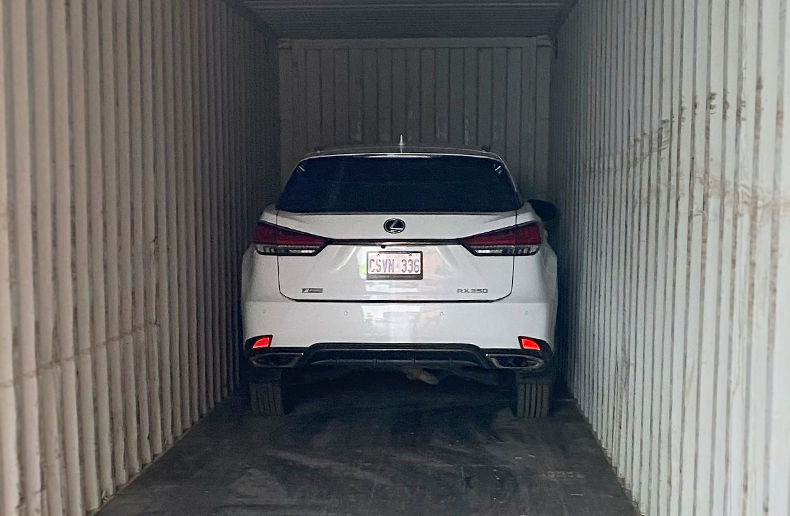
At the start of August 2026, the Royal Canadian Mounted Police (RCMP) and the Canada Border Services Agency (CBSA) announced the results of a pilot project known as Project NoCargo. Launched a year ago to prevent the export of vehicles obtained through fraudulent means, the operation was conducted in cooperation with INTERPOL Ottawa, the CBSA and the Financial Transactions and Reports Analysis Centre of Canada (FINTRAC).
Organizations like the Insurance Bureau of Canada (IBC) and the Équité Association both say the project is an important step and proof that coordinated efforts can disrupt organized criminal networks.
“I think it’s an important success story. It’s a strong demonstration of what can be achieved when governments and law enforcement agencies, border authorities and industry partners all work together,” says Hanna Beydoun, the IBC’s director of auto policy.
Launched in June 2025 with the goal of investigating suspicious vehicle exports, one of the project’s key objectives was to rapidly identify and prevent these exports through Canadian marine ports. The Équité Association says its participation included providing expert examinations to identify vehicles and their origins.
“Criminals commit vehicle finance fraud by stealing or manufacturing personal credentials, which are then used to apply for auto loans to purchase a vehicle,” the RCMP’s announcement notes. They also note that the same credentials are in turn used to take out insurance policies on the vehicles in question, with the intention of committing fraud.
The IBC’s 2025 figures put the number of auto theft losses at approximately $720 million. This is a more moderate number than those recorded in recent years when the figure peaked at more than $1 billion, but still more than double the $340 million reported 10 years ago.
Beydoun says next steps need to include making vehicles more difficult to steal in the first place. To that end, the association is currently advocating for the government to move forward with proposed amendments to the Canadian Motor Vehicle Safety Standards. “Those are amendments that would bring vehicle immobilization standards in line with international requirements,” she says. “We’re eager for government to move and implement those changes.”
Including vehicle finance fraud in the figure, the RCMP’s numbers suggest there was an estimated $900 million in insurance losses last year.
“Vehicle finance fraud, often driven by organized crime networks using synthetic identities and stolen credentials, is an evolving threat,” Bryan Gast, Équité’s national vice president of intelligence and investigations, explains in his correspondence with the Insurance Portal.
He similarly adds that the collective focus must now shift to preventing fraud from happening in the first place. “We must make it significantly harder for criminals to leverage synthetic IDs to purchase and steal vehicles,” he says. “The reality is that traditional identity verification and credit assessment processes are no longer sufficient to address today’s increasingly complex fraud schemes.”
Project NoCargo was launched after INTERPOL Ottawa detected an emerging trend of transnational organized crime networks exporting fraudulently obtained vehicles overseas. It has reportedly intercepted and recovered 392 vehicles during the year, with an estimated total value of $28 million.