Wildfire season in Canada has become longer and more intense. The consequences for the property and casualty insurance sector have also become more severe, with growing insured losses. But concerns about smoke exposure, respiratory illness and other health impacts are raising another question: how prepared are life and health insurers for the growing health risk associated with wildfires?
While insurers have acknowledged that climate change needs to be considered when designing private health insurance policies, they aren't yet ready to say how those risks might affect coverage, premiums and claims, or to provide specific figures.
Wildfire season is getting worse
According to a 2026 report from the Canadian Climate Institute, the 2023, 2024 and 2025 wildfire seasons were among the ten worst on record, with 2023 being the most destructive season. That year saw fires consume 16.5 million hectares, which is bigger than England. The area burned more than doubled the previous record and was nearly seven times the historical average.
The Insurance Bureau of Canada (IBC) reports that wildfires in Manitoba and Saskatchewan caused approximately $430 million in property and casualty insurance losses in 2025, while the 2024 Jasper wildfire resulted in $1.3 billion.
According to Statistics Canada, home insurance premiums rose 45 per cent over six years, notably due to extreme weather.
The effects of wildfire smoke
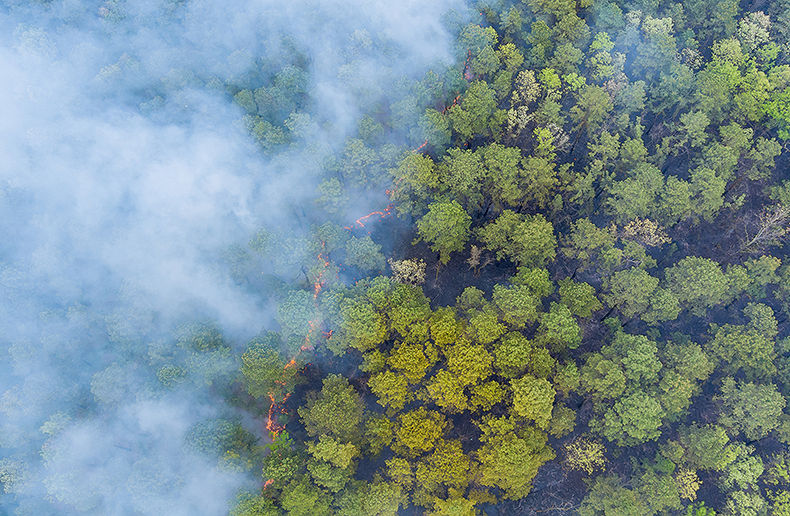
Wildfires affect health in two distinct ways, says Public Health Ontario's Dr. JinHee Kim. The first is through direct exposure due to location. The second is through exposure to smoke, which can travel hundreds or thousands of kilometres and affect large portions of the population as seen in 2023 when Southern Ontario and New York State were affected by the smoke from the wildfires in northern parts of Canada.
“What we know about wildfire smoke is that it tends to have very acute health effects, particularly in the respiratory system,” she tells Insurance Portal. “A day or two after exposure people can experience shortness of breath, cough, respiratory irritation as well as related hospitalizations. So, it's a burden on the healthcare system.”
One of the reasons why wildfire smoke has such acute respiratory health effects is its composition, says Mark Wilson, research director for the Center for Analytical & Exposure Science within UL Research Institutes’ Chemical Insights, based in Marietta, Georgia, in the United States.
He says that wildfire smoke contains PM2.5, which is fine particulate matter measuring 2.5 micrometres or less in diameter. An important factor in what makes wildfire smoke dangerous for people is the chemical composition of its PM2.5 particles, which can differ from the composition of those produced by other sources.
These particles can carry potentially harmful substances released by the materials consumed in a fire, he explains. “A lot of times, wildfires are mostly biomass, but when they encroach into populated areas, you start getting vehicles and houses and synthetics and all kinds of things, and that can add metals to the mix,” Wilson says. “That can add things from buildings, depending on the age of the building. That might be asbestos. That might be lead.”
According to Health Canada, people with existing heart or lung conditions, older adults, young children and pregnant women are among those most at risk from wildfire smoke exposure.
Even with this information, it’s still hard to quantify the health effects of wildfires, including their impact on mortality beyond the deaths directly caused by the fires. Dr. Kim says that while Public Health Ontario saw an increase in emergency department visits after the 2023 smoke event, it’s still difficult to draw a straight line between that increase in visits and mortality.
The threat of wildfires isn’t going away in the immediate future. Looking at the public system, Dr. Kim says one way to reduce the pressure on it is for people to prepare for the season by ensuring they have their inhalers for those who have asthma, and wearing masks if they need to leave the house.
Can health insurers keep up with climate change?
Insurance Portal reached out to life and health insurers to ask how the increase in wildfires might affect health insurance. But while none were willing to go on record for this article, the industry is already factoring climate-related health risks into its approach to group benefits.
A 2025 report from Sunlife in partnership with Environics, How climate and extreme weather are impacting workplace health in Canada: Creating a climate-resilient workforce with group benefits, notes that wildfire smoke can not only worsen respiratory conditions but also worsen chronic conditions like migraines, heart disease and diabetes.
Citing the Canadian Climate Institute, it reports that one week of wildfire smoke in June 2023 was estimated to have cost Ontario over $1.2 billion in health impacts.
The report also acknowledges the long-term impacts of climate change, such as longer pollen seasons and higher pollen counts, which can aggravate asthma and allergies. It also discusses mental health effects, including climate anxiety and post-traumatic stress disorder in those who were directly affected by extreme weather events like wildfires.
In addition, it highlights the impact on workplace productivity. Among employees reporting climate-related mental health impacts, 60 per cent said their work had been affected, compared with 54 per cent of those reporting physical health impacts. The insurer warns that employers could face increased costs related to disability and health benefits.
In its report, Sunlife suggests that group benefits plans could play a bigger role in addressing climate-related health risks.
For now, the health effects of wildfire smoke are clearer than their impact on insurance. Insurers are accounting for climate-related health risks, but how those will shape insurance coverage is still to be seen.