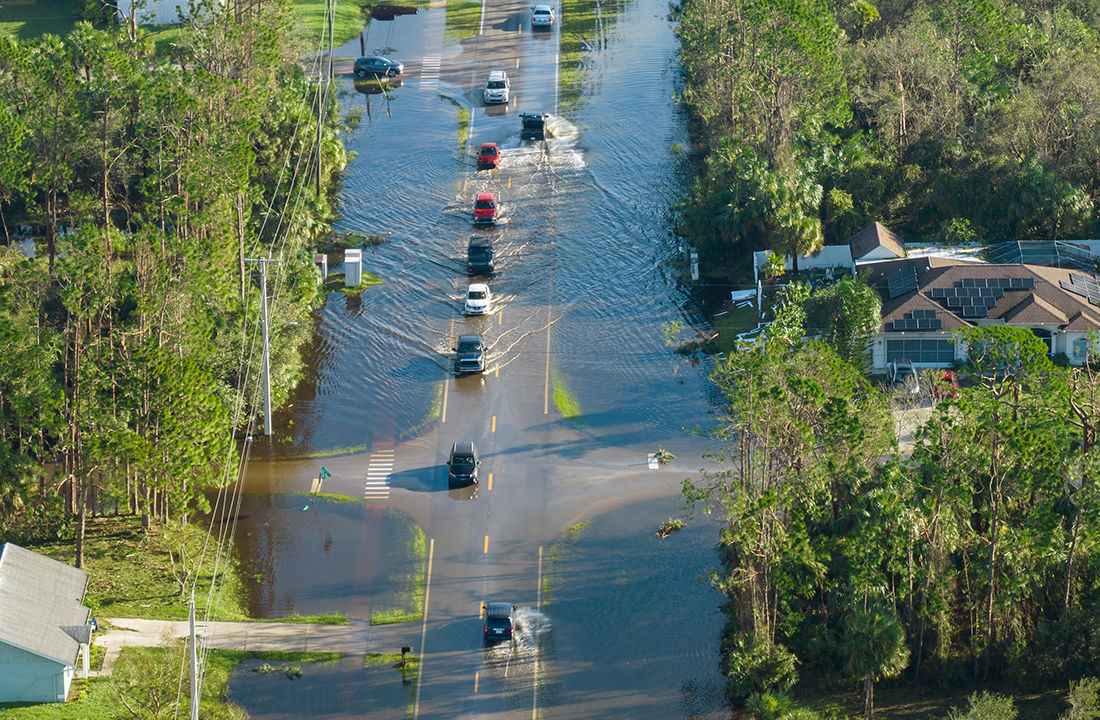
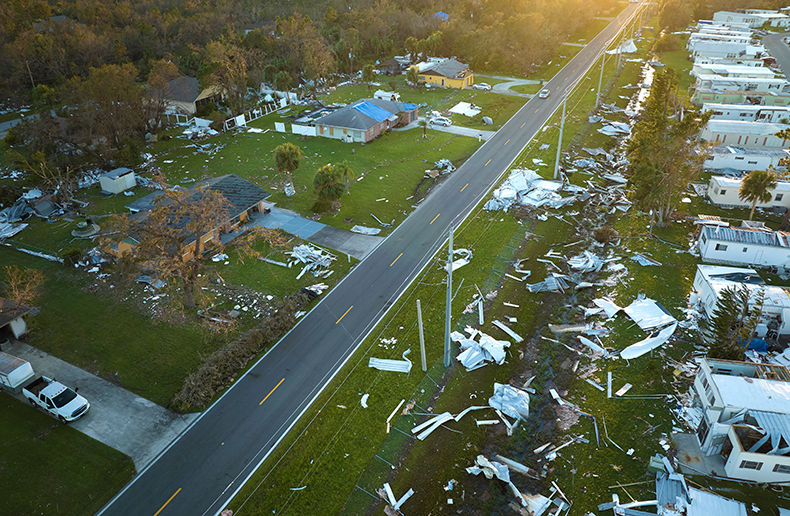
Canadian mutual insurance company CEOs have banded together to call on the Government of Canada to make climate resilience a national priority. From across the country, they warn that climate-related disasters are becoming more frequent, severe and costly.
In an open letter titled A Call to Build a More Resilient Canada, the 14 signatories point out that extreme weather events “are placing growing strain on Canadian families, businesses, infrastructure and public services. The human and economic impacts are significant, affecting housing affordability, community well-being, economic stability and long-term prosperity,” they warn.
“Canada has an opportunity to shift from a reactive approach that focuses on disaster recovery to a proactive approach that centres on resilience and adaptation,” they add. “We signal our commitment to working alongside governments, communities, Indigenous Peoples, businesses and civil society to strengthen Canada’s resilience.”
In the open letter, the CEOs call for:
- The promotion of climate-ready homes and infrastructure;
- support for retrofits and upgrades to existing buildings;
- a streamlined National Building Code of Canada to accelerate the adoption of such upgrades; and
- efforts to ensure that standards reflect the distinct climate risks faced by different regions across the country.
Signatories to the letter include CEOs from Ayr Farmers Mutual, Beneva, the Canada Co-operative Business Association, the Canadian Association of Mutual Insurance Companies (CAMIC), Co-operators, The Commonwell Mutual Insurance Group, Desjardins General Insurance Group, the Municipal Insurance Association of British Columbia, Promutuel Assurance, Red River Mutual, Sandbox Mutual Insurance, The Mutual Fire Insurance Company of British Columbia, Trillium Mutual Insurance Company and Wawanesa.
“We want to demonstrate the leadership our communities expect from us and send a clear message that climate adaptation and resilience must be a top priority for government,” Beneva president and CEO, Jean-François Chalifoux noted in his statement to the Insurance Portal regarding the letter. “Insurers see the impacts of severe weather on families, business and communities and we expect these risks to continue to grow.”
The sentiment is similarly expressed by other signatories, as well. When asked why the competitors have joined together in issuing the communication – the Insurance Portal canvassed all 14 organizations to get their perspectives – one emergent sentiment across the board is that insurers have this understanding about the impacts of climate change given their front row to the damages and disruption that severe weather can cause policyholders.
“This ties back to our mutual and cooperative roots. As organizations, we’ve always been in it for that end policyholder. We feel it’s one of our responsibilities to pick up that torch and look to do something on behalf of the rest of the policyholders within the Canadian marketplace,” says Sandbox Mutual Insurance CEO, Rob Jones.
“As an industry, we see this as a collective problem,” adds Michelle Laidlaw, assistant vice president of national home product and portfolio with Co-operators. “We really feel passionate that in the absence of a climate solution, attacking this problem from both the front end of the problem – which is building stronger homes, building more resilient homes, protecting that new home inventory or new building inventory, as well as addressing climate resiliency after losses occur – in the absence of that, there will continue to be challenges in affordability and availability for Canadians.”
Tim Shauf, CEO of The Commonwell Mutual Insurance Group says the move to show unity and solidarity on the file will hopefully be what is needed to ultimately effect change. “You just need to give things a little bit of an extra push and see if you can generate a little more momentum,” he says.
Those discussing the matter with the Insurance Portal add and point out that the industry is not seeking a handout either.
Cost and volatility
“We look at the cost and the volatility. That is a significant concern for us, but that’s the business we’re in. We understand that, but we know there are a lot of underlying factors and contributing factors that can and should be looked at,” Shauf adds. “Sometimes we just need to speak up. We’re not looking for a made-in-government solution to be handed to us,” he adds. “We have a part to play.”
Laidlaw similarly states that the industry is not simply asking the government to make changes happen. “We are not just saying ‘please build resiliency into communities,’ we are also participating in building resilience into those communities,” she says. “It’s part of our cooperative nature and why we do things differently.”
The mutual insurers’ almost collective perspective is also that a focus on building codes and heartier rebuilding efforts would mean fewer claims which, they add, is better for all involved.
“Let’s get ahead of the loss rather than continually paying to recover from it,” Jones says. “Invest in climate resistant infrastructure. From a government perspective we need to make it easier to retrofit existing homes and buildings. We need to strengthen building standards, and we certainly need to modernize the National Building Code so that resilient construction practices continue to be adopted a little quicker than they are today.”
Geography a challenge
Shauf, in his discussion with the Insurance Portal, notes the challenges associated with applying solutions to a country with a geography like Canada’s where the risks change notably from one region to the next. Jones also notes that too often the conversation about resilience measures is only being had following a destructive event.
He additionally notes the challenge of finding practical resilience measures that require a modest investment up front, but which can prevent more expensive losses later. Making the effort, however, is better for homeowners, insurers, taxpayers and communities in general, he adds.
The National Building Code, meanwhile, poses a challenge for those charged with the task of reviewing the code in 2030 – Laidlaw points out that what is needed in a fire zone and a flood zone may be completely different measures.
“There are some inherent challenges in climate resilience in Canada as a general rule. What you need to do for climate resilience in, say, Western Canada where you’re dealing with significant wildfire, hail in Alberta, versus Atlantic Canada where they’re managing wind and hurricanes and flooding. It is significant,” she adds. “We have a very significant landmass and there are significantly different challenges across the country.”
Governments listening but action lacking
At the Co-operators, Laidlaw adds that the federal government would appear to be “actively listening” to the discourse about climate resiliency. Jones also points out that several groups related to the insurance industry have been active in lobbying the government to consider climate risks in its agenda.
“The federal government is taking it quite seriously. I think we need that same level of approach at both the provincial and the municipal level. That would extend down to the individual insurance companies, construction companies and anybody else associated with the challenges that we’re experiencing,” Jones says. “We need the same at the provincial and municipal level.”
At CAMIC, the association’s president and CEO, Sangita Kamble writes that “the government may be listening, but action needs to be taken.” She adds that earthquake considerations were present in the last budget “but other climate related adaptation methods are lacking.”
Laidlaw also says while the Federal Budget 2026 contained a lot of positive items, “that budget missed a critical opportunity to really strengthen Canada’s economic resilience to extreme weather.”
Collective action needed
In short, the signatories to the open letter say they are looking to amplify their respective voices by joining together, in an effort to drive collective action. “The problem we see, the increasing frequency and severity, and the cost of what severe weather is doing to our portfolios and subsequently to the affordability and the availability of insurance for Canadians – climate risk is really becoming a financial security challenge for Canadians. Many households lack the resources to recover,” Laidlaw points out.
The affordability and availability problem, meanwhile, she says, is also a problem which can’t be solved without collective action from government, the industry and other partners in the market. “A collective approach is critical to addressing that challenge.”
She adds: “We are in a critical time. We really need to address the resilience of Canadian homes.”
In a statement, Wawanesa president and CEO, Evan Johnston writes that the company sees firsthand the devastation that severe weather can have on people and communities. “Addressing the growing impacts of climate change is bigger than any one organization,” he writes. “We hope to bring greater attention to adaptation, encourage broader collaboration among governments, industries and communities on measures to reduce risk and reinforce the need for collective action to help Canadians become more resilient.”
Jones puts the mandate simply: “Our role shouldn’t just be to help people recover. We need to be part of the conversation about how we reduce that damage in the first place,” he says. “(Having) more voices take this to the government level is fundamentally important.”