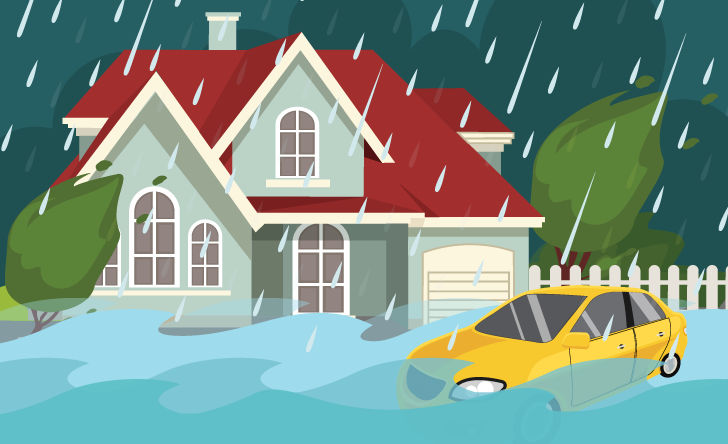
Climate change is irreversible, and although the industry is currently well-positioned to absorb recent losses, according to reports, others say it is past time to involve the public – homeowners in particular – in flooding and wildfire mitigation efforts.
“Disasters occur and there’s a lot of excitement about getting people back into working order following the event. The problem is we’re not getting ahead of the curve,” says Dr. Blair Feltmate, head of the Intact Centre on Climate Adaptation at the University of Waterloo. “We know exactly what needs to be done. I would start with the homeowner. This is where I think we have the most potential to get the most risk out of the system, almost instantly, for very little money or (homeowners’) technical expertise.”
The Intact Centre on Climate Adaptation has also put together infographics to guide the public in taking precautions. Feltmate notes that 70% of homeowners receiving these infographics on flooding preparedness (the centre also publishes infographics on wildfire preparedness and preparedness for extreme heat events) will take at least two actions within six months to protect their homes, which they wouldn’t otherwise have taken.
“In other words, people will protect their homes when they know what to do. The reason they're not doing it is they simply don't know what to do,” he says.
He adds that in Canada, it is generally understood what the key perils are and where they are going to manifest over time. “Flooding and wildfire are the two big ones,” he says. “We know the problems and we actually know the solutions. We know a great deal about what needs to be done at both the community level and at the house level to mitigate flood risk. The problem is we’re not applying known solutions to known problems nearly quickly enough. We have to move much more rapidly.”
Latest figures don’t account for recent storms
The most recent figures from the Insurance Bureau of Canada (IBC) are concerned with the storms which occurred in late June and early July when thunderstorms across Ontario and Quebec caused an estimated $439 million in insured damage.
This estimate does not include damage from the flooding that struck the Ottawa region on July 1. The damage from that event, along with damage caused by a series of storms in St. Catharines between July 21 and August 2, is expected to be addressed in additional releases from IBC in the coming days.
Most recently, last week’s storm in Toronto on September 2, is estimated to have caused insured losses approaching $1 billion, according to analysis from Morningstar DBRS, entitled Canadian Insurers Remain Well Positioned Despite Elevated Severe Convective Storm Losses. Should those estimated losses be realized, Morningstar says it would be the costliest loss event of the year and among the largest storm-related catastrophes to affect Canada in recorded history.
“Adding our preliminary estimate for the latest storm to our H1 2026 estimate of $1.5 billion, the total insured losses for 2026 would exceed $2.5 billion,” they write, adding that this is comparable to the catastrophic loss claims incurred in 2025.
The report notes that the majority of losses will likely remain uninsured because overland flood insurance is typically sold as optional coverage and penetration rates remain limited. “Commercial flood claims are expected to be larger given the multiple flooding incidents, as well as the widespread coverage uptake and availability,” they write. The Morningstar report also notes insurers’ underwriting profitability, risk management and pricing discipline, and lower reinsurance prices.
“While we expect some large commercial losses to emerge as a result of the September 2 storm, those claims are likely to be reinsured and losses spread across multiple carriers. Accordingly, we expect Canadian insurers within our rated universe to effectively absorb the ensuring claims through earnings and reinsurance protection.”
Figures on Cape Breton’s flooding over the Labour Day weekend will likely begin to become available 30 and 45 days following the event.
Statistics Canada weighs in
A separate report released September 3 by Statistics Canada, Analysis of residential properties and homeowners in high flood hazard areas, meanwhile notes the size of the problem by counting the number of houses built on flood plains.
It found that the highest proportion of residential properties building in high flood hazard (HFH) areas in census metropolitan areas (CMAs) and census agglomerations (CAs) in Manitoba, British Columbia and the Yukon, where 39.5 per cent, 7.1 per cent and 5.1 per cent of housing stock is located in an HFH area. (HFH areas overlap with 100-year return period floodplains 80 per cent of the time or more.)
“Newer constructions – those built from 2016 to 2022 – in Manitoba, Saskatchewan and British Columbia were comparatively more likely to be located in HFH areas than those built in prior years,” they write. “The CMAs and CAs of Winnipeg, Chatham-Kent, Chilliwack and Vancouver had significant residential flood hazard exposure, with a large number and share of residential properties located in HFH areas.”
The paper notes that Public Safety Canada in 2022 estimated that the average annual loss from flooding for residential properties across Canada was $2.9 billion. It also notes that as governments and developers work to expand housing supply, there is a risk that urgency to build or intensify development could lead to increased housing in areas that are more vulnerable to flooding.
“In Manitoba, almost all these properties were concentrated in the Winnipeg CMA, which is protected by the Red River Floodway – the largest floodway in Canada. Notably, Manitoba accounted for over one-third of all properties in HFH areas identified in this study,” they add. “A total of 112,085 residential properties in the Winnipeg CMA were in HFH areas, representing 45.1 per cent of its residential property stock, the highest among all CMAs and CAs studied. Importantly, the Winnipeg CMA accounted for nearly all (98.7 per cent) of Manitoba’s properties located in HFH areas.”
Home values fall
Back at the Intact Centre on Climate Adaptation, Feltmate points to the centre’s research which shows that home values in flood-affected communities fall 8.2 per cent, whether the homes in question are affected or not. He adds that about six per cent of homes across Canada today (about 850,000 homes) are uninsurable for flooding.
Interestingly, upcoming research from the centre also points to costs for life and health insurers, as well – it studies the mental health impact of flooding and found spikes in prescription drug claims for psychosocial and mental health concerns, in the use of counselling services and in the number of lost working hours in flood-affected areas. Feltmate says he expects the results would be similar in wildfire affected regions, as well.
“It implicates a whole other industry sector that previously thought it was off the hook, life and health insurance,” he says. “This shows that they’re front and centre.”
Known solutions
Feltmate says the communication of easy-to-follow guidance to homeowners is important. To that end, the centre has developed infographics for homeowners which show actions that can be taken around the house to reduce the risk of flooding. Among the list of suggested actions, the literature focuses on sump pumps, backwater valve maintenance, grading and community-level risk management, including the creation of flood risk maps and scores, watershed and shoreline management and community awareness measures.
The centre’s research finds that 53 per cent of those surveyed don’t maintain their backwater valves from one year to the next. In a survey of homes in New Brunswick, Quebec, Ontario and Saskatchewan, 70 per cent had landscape grading towards the house, rather than away from it.
“People think expressions of extreme weather are bad now, but they’re going to get worse going forward, period. We can’t reverse climate change, we can only slow it down,” Feltmate says. “It is all the more pertinent that people understand the actions they should take to protect their homes.”
To that end, he suggests the federal government launch a national home flood protection education program and a national home wildfire protection education program. “Helping homeowners help themselves should be top priority,” he says.
He also recommends real estate agents, home inspectors and particularly insurance agents be required to complete continuing education on the subject. He also recommends the infographic material be distributed with new mortgage packages. Today the centre’s material is being provided by the Bank of Montreal, RBC, credit unions, Intact Financial Corporation, Foresters Financial and a number of others.
“I would ultimately bring it down to homeowners,” he adds. “Educating homeowners on actions to protect their homes from flooding or wildfire is by far the greatest return on investment we can realize in this country, relative to mitigating the costs otherwise associated with climate change and extreme weather risk.”