
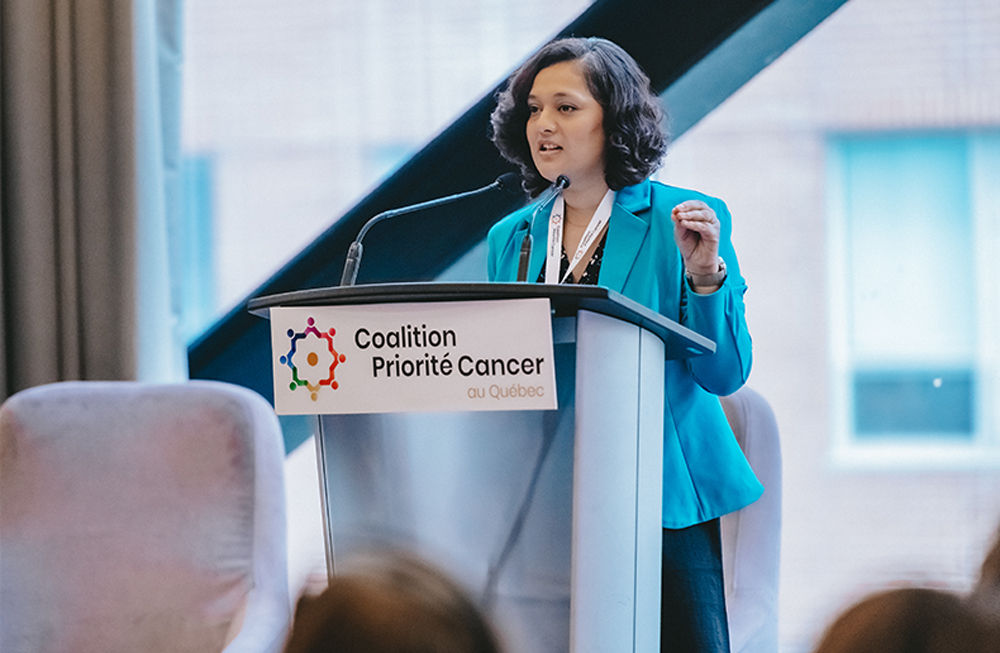
At 36 years old, Alvina Nadeem, an engineer and change management consultant, was diagnosed with an aggressive form of ovarian cancer. She underwent surgery that included the removal of her uterus, ovaries and fallopian tubes, triggering immediate menopause. This was followed by six months of chemotherapy, until she finally received the good news: there were no more signs of cancer.

However, her journey toward physical, cognitive and emotional recovery was far from over. As a patient-partner with the Quebec Cancer Priority Coalition, she shares her story in the hope of improving the quality of care and services offered to patients. “Insurance companies can be much more than a financial safety net,” she tells Insurance Portal. “There is room to be an active partner in the recovery and life-rebuilding process for people affected by cancer.”
Providing support after treatment ends
Contrary to popular belief, “getting back to a normal life doesn’t begin when treatment ends,” says Nadeem. How can we expect a skier with an open tibia fracture to hit the slopes right after surgery, without rehabilitation? Nadeem says she felt as if she had aged a hundred years. “I felt completely disconnected from my own body,” she says. “It was like driving a car that had been in an accident.”
She also felt adrift after suddenly losing contact with her care team, struggling to cope with the lack of support. The end of chemotherapy also brought the unsettling feeling that she was no longer protected, and that the cancer could return at any time. “That’s the phase when you’re left alone with your thoughts, and your fears keep looping in your head,” she confides.
Delivering proactive support
While rest was essential to help Nadeem regain her energy, it wasn’t enough. “After a few weeks, I told myself I wanted to get back in shape,” says the mother of two young boys, aged four and six at the time. She wanted to be able to play and be active with them, but even a short walk would send her heart rate soaring.
“After the rest phase comes the recovery phase,” she says. “You need to be proactive in rebuilding both your physical and mental health.” Nadeem wishes her insurer had checked in on her recovery progress and referred her to the right specialists. “If I hadn’t sought out resources myself, nothing would have happened,” she says, lamenting the lack of transparency about available services.
Building a team around the patient
“I had to build a team around me, but I needed someone to guide me,” recalls Nadeem. Her experience as a patient-partner helped her know what questions to ask. She also had the good fortune of having a family doctor and some financial means. “But luck shouldn’t be a determining factor in whether or not someone can successfully return to work,” she says.
Her doctor first recommended working with a kinesiologist, who assessed her physical condition and designed a personalized exercise program to help her regain strength safely. However, because her insurance didn’t cover it, she had to pay out of pocket. She also needed physiotherapy when stiffness and pain began to appear.
Nadeem was also supported by a psychotherapist, who helped her manage anxiety and build resilience in dealing with the after effects of cancer. Finally, at her request, her doctor prescribed mental health occupational therapy to prepare her return to work. The specialist evaluated her job tasks, functional abilities and work environment before recommending the necessary adjustments for a sustainable return.
Better support for returning to work
One year after chemotherapy, Nadeem returned to work on a gradual return-to-work plan. Even with a flexible employer, some moments were difficult. For example, she was surprised to lose access to her mental health occupational therapist once she returned to full-time work. Yet it was at that point—when she took back her full workload—that she needed accommodations the most, Nadeem points out.
Employers are legally required to make real and reasonable efforts to accommodate employees. But according to Nadeem, if issues arise during reintegration, “the burden falls on the patient.” The person is faced with the choice of educating their employer—at the risk of damaging the relationship—or staying silent and risking burnout, she notes.
Collaborating with all stakeholders
Nadeem is convinced: finding solutions to ensure people affected by cancer can return to work safely and sustainably benefits everyone. The patient wants to reclaim their life and thrive, the employer wants their employee to be as productive as possible, and the insurer wants the policyholder to return to work in order to limit costs.
To achieve that, she believes it’s crucial to “co-create and transform together, with a focus on collaboration.” What if insurers partnered with patients to design offerings that truly address the challenges of illness? What if they took on the role of educators for employers, and became engaged stakeholders for patients throughout the recovery process?
That conversation has already begun. Several insurance companies participated in the Cancer & Work Symposium hosted by the Quebec Cancer Priority Coalition last May. The goal: to address the urgent need to properly support cancer patients in the workplace. Especially since a significant portion of those diagnosed with cancer are of working age. “In Canada, nearly 40 per cent of individuals diagnosed with cancer are between the ages of 20 and 64,” notes the Canadian Cancer Society.
Cancer and work: A collaborative initiative
Cancerandwork.ca is a free bilingual website co-founded by Christine Maheu, researcher and associate professor at McGill University, and Maureen Parkinson, a vocational rehabilitation counsellor with the British Columbia Cancer Agency. It offers a wealth of evidence-based resources to support cancer survivors in returning to work, staying employed, and managing workplace challenges after diagnosis.
The site includes dedicated sections for survivors, health care professionals and employers. Insurers are also part of the initiative, as shown by a recent partnership with Desjardins Insurance. According to Maheu, one of the goals of this collaboration is to develop best-practice guides to help equip employers to provide real and sustained support to employees affected by cancer.