
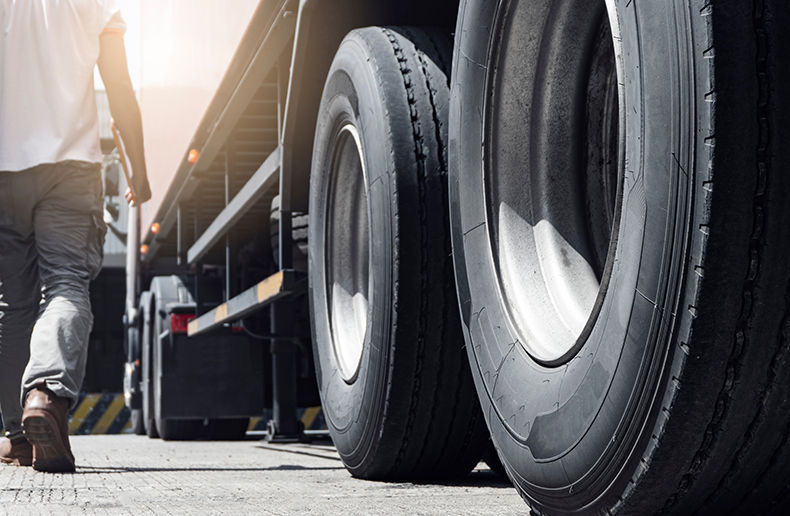
The trucking industry remains fragmented in Canada. According to figures from Statistics Canada, the country had about 154,000 establishments in the truck transportation sector in 2025. Approximately 66 per cent of these are classified as businesses with no employees or with an undetermined number, which includes owner-operators who drive the truck they own.
Of the roughly 52,000 establishments that paid wages, 83.4 per cent had four or fewer employees, while 16.1 per cent had between 5 and 99 employees. There were 231 companies with 100 to 499 employees (0.4 per cent) and only 11 with more than 500 employees.
For small businesses or those looking to enter the trucking sector, access to insurance remains difficult, acknowledge the brokers contacted by the Insurance Portal.
According to Scott Cober, National Practice Leader, Transportation, at BFL Canada, small trucking businesses are at a disadvantage. “For companies with fewer than five units, these are filed rates. We can’t really negotiate with an underwriter,” he says, adding that competition helps secure acceptable insurance premiums.
The main disadvantage of these micro-enterprises is that they are not able to easily recruit new drivers. “Insurance companies are requiring three years written proof of past employment and past insurance history through LOE's (letters of experience). These time delays to on-board new drivers and the inconvenience of contacting past employers is causing good drivers to look at larger fleets with internal safety departments and mentoring programs to hire drivers with less than 3 years on-road experience,” adds Cober, who sits on a working group of the Professional Trucking Alliance of Canada (PTAC).
His colleague Francis Goyer, a broker at BFL Canada’s Montreal office, notes that small firms do not have the means to invest in prevention and driver training. “A new company, with a few trucks and drivers who do not have three years of experience, will unfortunately end up with imposed pricing,” he says.
Matteo Caputo, Senior Vice President, Account Executive at Hub International, notes that due to the current appetite of insurers looking to grow their portfolios, “I don’t see any problem” for an owner-operator who wants to start a business after completing a year of training at a transportation training centre.
Forestry transport and snow removal
Even though the soft market in commercial insurance affects the trucking industry, there remain activities involving heavy vehicles for which brokers must work hard to place risks. This is particularly the case for passenger transport, forestry transport and the snow removal industry.
“Specialized transportation insurers don’t want to touch snow removal,” explains Martin Burrowes, president of Burrowes Insurance Brokers. This activity generates a high number of claims, often for small amounts due to minor collisions with other vehicles.
“If I have a client with 10 trucks, five of which are used for snow transport in the winter, it will be difficult to find insurance. If it’s a large client and only a small portion of the fleet is used for snow removal, the insurer will cooperate,” he continues. For companies that only do snow removal, the firm will instead use the capacity offered by insurers in its commercial lines division, rather than placing the risk with a transportation specialist insurer.
On the forestry transport side, insurers remain reluctant to cover this activity. “There still isn’t much appetite for it. It’s such a high-risk type of transport for insurers, there are far too many claims relative to the premium. Forestry transport is covered through small programs, or by insurers who are not familiar with transportation and end up with it. Specialized insurers do not get very involved in forestry transport,” says Martin Burrowes.
Alexander Christie, a transportation broker at Gallagher, notes that forestry transport remains a problematic industry for insurers. “I think that's an industry problem, not just a location problem. Logging and forestry is always a high-risk. It's a lot of wear and tear on vehicles,” he says.
Log hauling, meaning the transport of felled and delimbed tree trunks, is no small matter, he adds. “The shifting of the logs causes rollovers all the time. I've had one fleet in northwestern Ontario. The amount of claims that these guys were having, I felt like it was one every week,” Christie adds.
His impression is the same for insurance of heavy vehicles used for clearing roads or transporting snow. “Unfortunately, all parties involved in snow removal represent a high risk for insurers because of slip and fall claims,” explains the Gallagher broker.
In provinces where private sector competition exists, Scott Cober confirms that certain heavy transport segments remain difficult to underwrite. “Operators of heavy vehicles in forestry, agregate or snow removal all face higher-than-average premiums due to their history,” he says. In his view, the use of specialized wholesalers is sometimes necessary for these clients.
For school buses or passenger transport, Cober notes that even though the market is dominated by Northbridge, other insurers have begun to offer capacity in this segment, which helps brokers place risks.
Erasmo Hurtado, a broker at Hub International, notes that for more specialized activities, “the insurer creates a program and people stay there, because it’s the only option. The insurer decides whether to renew the policy or not.” In the case of forestry transport, he points out that severity is a real issue, as log-hauling trucks are very costly and operate on difficult roads where breakdowns are frequent.
His colleague Robert Desmarais, a risk prevention specialist at Hub, notes that forestry carriers are making significant efforts in prevention and safety. “Many carriers are beginning to understand that prevention helps limit breakdowns, downtime and claims,” he says, adding that the more limited appetite of insurers forces carriers to be more disciplined.
Nuclear verdicts
Liability coverage needs remain for truckers who must cross the border between Canada and the United States. In several states, court decisions following accidents involving bodily injury and heavy trucks have resulted in “nuclear verdicts” against carriers. This was the case for a Montreal carrier in an accident that occurred in Florida in 2017.
Martin Burrowes explains that in some cases, if the carrier is solvent, actions brought by plaintiffs’ attorneys in the United States can lead to awards that exceed liability coverage limits. “Some think that once their policy limit is reached, that’s the end of it. There have been claims settled for amounts higher than the coverage,” he says.
In researching this file, Insurance Portal found numerous articles highlighting issues related to “for-hire drivers” who operate delivery trucks for subcontractors of the giant Amazon. “The situation is similar in Canada, maybe even worse,” says Martin Burrowes. Carriers would like the contracting party “to bear some moral risk when using illegal carriers. For now, they are not held responsible, so they go with the lowest bidder,” he adds.
Moreover, it has been reported to him that attorneys pursuing transportation companies in the United States have changed their approach in recent years. Cases are more often settled out of court, without a judge needing to intervene. Insurers are also willing to settle disputes as quickly as possible. “Cases that used to take five years can now be settled in two and a half years. It’s still long, but less than before,” notes Burrowes.
Alexander Christie points out that Winnipeg is located about 90 minutes from the border. “I would say 99 per cent of our trucking portfolio, at least half of the trucks go to the United States,” he says.
“The USA is a more litigious country than Canada is. You tend to see large losses for things that, in Canada, would not be large losses. I've seen a loss where there was an $8 million demand coming out of California, and that loss in Canada would be 100,000 dollars. That’s a difference in severity in the United States. From an insurance company perspective, that's a lot of premium dollars in capital to be tied up. I would say that the frequency of litigation has fallen, but severity has not,” Christie adds.
Cargo theft
On the cargo theft side, loss experience has been fairly stable in recent years, according to Martin Burrowes, who notes that frequency was higher before the COVID-19 pandemic. Criminal networks are active in this area “and there are no resources in Quebec to catch these people,” he says. “Non-violent crimes are a lower priority.”
For his part, Alexander Christie notes having observed a certain increase in claims in this regard, particularly in the Greater Toronto Area. “We’re also seeing it in Manitoba. We had one where it was in the middle of the night, and it was definitely organized crime. It was a skilled driver, hooked up a flat deck trailer full of lumber. He was in and out for about six minutes. It was in a rural place outside Winnipeg, a typical rural area with a lot of trucking,” he recounts.
He also observes increasing sophistication in cargo theft, especially in long-haul transport where the driver must stop at more than one location. “The level of crime on cargo has definitely evolved in the last 10 years, and not in a good way,” Christie notes.
Scott Cober adds that criminal networks are using new technologies to create false documents to deceive carriers into delivering their cargo to fencing operations. “Food products are hot right now. And theft in the Greater Toronto Area is a problem that is not improving,” he says.
Francis Goyer observes, based on the claims submitted to him, that criminal networks “show impressive creativity in fraud.” Identity theft and digital fraud are on the rise and policy limits should be adjusted accordingly, he suggests.
Until 2023, cargo theft mainly affected consumer goods. Since then, “I am seeing a resurgence of theft involving commodities in the metals sector: aluminum, iron and other non-ferrous minerals. They resell well and are difficult to identify,” Goyer continues.
For his part, Matteo Caputo says he has not observed an increase in claims related to cargo theft. His colleague Erasmo Hurtado confirms that loss experience is evolving, notably due to the high cost of trucks, but the frequency of theft does not appear to be higher.