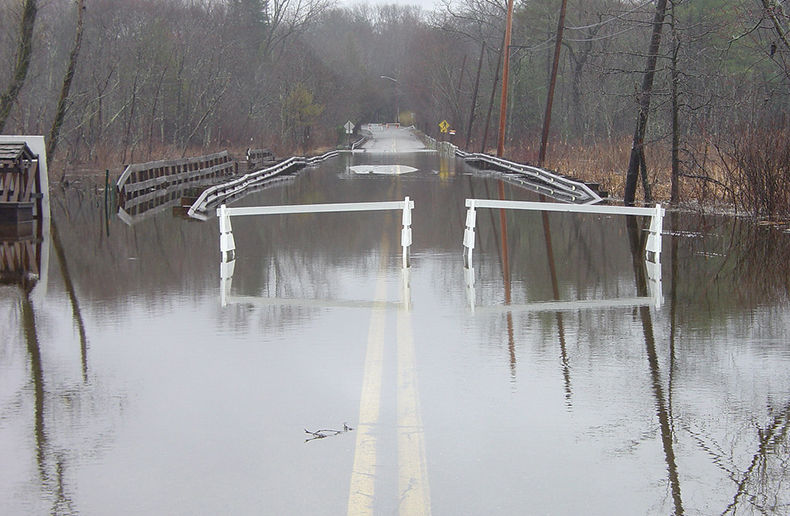
Questioned by the parliamentary press on April 21 in Ottawa, at the height of the spring floods affecting several communities across Canada, federal minister Eleanor Olszewski said she couldn’t promise the Canadian government will deliver the National Flood Insurance Program “in the near future.”
Her comment appeared in a dispatch by Nick Murray, a journalist with The Canadian Press, and was picked up by CBC. Olszewski confirmed that the federal government is still studying the possibility of creating such a program and that it remains a priority.
According to her, the mechanism to be put in place is complex, particularly when it comes to determining the most viable structure for such an insurance program. She did not identify the obstacles causing concern.
Olszewski is Minister of Emergency Management and Community Resilience in the government of Mark Carney. She is also the minister responsible for the Prairies Economic Development Canada and the member of Parliament for Edmonton Centre in Alberta.

In a telephone interview with Insurance Portal, Liam McGuinty, vice-president, federal affairs at the Insurance Bureau of Canada (IBC), reacted favourably to the announcement. “If the federal government proceeds with the National Flood Insurance Program, it has to be tailored to the current context,” he says.
“Since we began talking about such a program many years ago, the overland flood insurance market has evolved. Our industry and our underwriting now cover 90 per cent of risk,” notes McGuinty.
“You are seeing increased risk appetite and more sophisticated underwriting,” he continues. “You’re witnessing an overland flood insurance market that’s functioning as it should. The message to government has been very consistent: take the time to design this properly. Getting the design right matters a lot more than rushing to implementation.”
The protection gap
Compared with the situation described in the 2022 report of the Task Force on Flood Insurance, created by the Canadian government to deliver on the 2019 election promise made by former prime minister Justin Trudeau, the protection gap between economic losses associated with flooding and insured damage has narrowed significantly, says Liam McGuinty. “We’re not dealing with a broad absence of coverage anymore. So, the problem definition has changed,” he says.
“The challenge is a narrower coverage gap. It is concentrated in the highest-risk properties, and that’s often tied to location decisions and lagacy land-use patterns,” he adds. “The market is responding to the overland flood coverage gap, thanks in part to better modelling and an increase in risk appetite.”
McGuinty insists that the insurance industry cannot, on its own, resolve the problems Canadians face due to flood risk. The value of claims associated with this peril has increased by 300 per cent over 20 years, according to IBC.
Home insurance premiums are rising, but this increase is a symptom of a deeper issue: “The problem is that we are not resilient enough to a changing climate, and flood is our number one climate peril. We’ve always been calling for a flood program that is tightly scoped to highest-risk households,” he says.
Such a program would then complement a private market that is functioning adequately, but it must also be accompanied by measures aimed at increasing community resilience, according to McGuinty. “We got to make sure that we are doing the right things, alongside or in support of a flood program. This includes flood mapping, retrofit, investing in resilient infrastructure, all things that protect our existing housing stock.”
It also means not making the problem worse. “We must also start building new homes the right way, which means more resilient standards through our provincial and national building codes.”
He cites a study by the Canadian Climate Institute which warned that, due to the urgency of addressing the housing crisis, there were concerns that new buildings could be constructed in flood-prone areas. “We’re going to build more than 500,000 homes in high-risk flood areas. In our view, this is a conversation much broader than insurance. This is about good resilience public policy from all levels of government,” explains McGuinty.
Since the publication of the Task Force report, the figures show that while the protection gap has narrowed, the reality remains: about 1 per cent of properties—those located in the highest-risk areas—account for roughly 40 per cent of all flood-related losses, according to McGuinty.
Heavy rainfall
Spring flooding is once again occurring in 2026. In Quebec, neighbourhoods in Rigaud and Gatineau, among the municipalities affected by the floods of 2017 and 2019, have once again been inundated this year. “I think you’re seeing areas that are traditionally not known to be susceptible to flood to be now faced with higher flood risk. You’ve seen that in parts of Quebec, Ontario and elsewhere in Canada,” notes McGuinty.
In his view, the trend is very clear: among all climate hazards, flooding is the most costly. “The takeaway for us is our defenses have not caught up to the increase in risk,” he says. “We just have not made the decisions that we need to ensure we’re safer,” concludes McGuinty.
Other reactions
Researcher Bernard Deschamps, former chief executive officer of the Mutuelle des municipalités (now the Fonds d'assurance des municipalités du Québec), notes that the federal government already has a program, the Disaster Financial Assistance Arrangements (DFAA), which was modified in 2025 to include incentives aimed at mitigating risk.

The National Flood Insurance Program “is modelled on Flood Re in Great Britain,” he writes. “It is a political project, encouraged by the insurance industry, which would have preferred to transfer the burden of the protection gap to the public sector,” he continues.
This British program contains a flaw that the Canadian proposal would replicate. “By capping premiums, it removes the price signal and provides no real incentive for citizens to reduce their own exposure to risk,” notes Deschamps, who has just completed doctoral studies specifically focused on flood risk reduction.
The UK government created Flood Re to compensate for the withdrawal of private insurers. In Canada, the situation is different, as insurers did not cover overland flooding prior to 2015. The coverage currently offered remains “very limited, particularly in Quebec,” according to Deschamps.
He concludes: “Provinces, municipalities and citizens will have to assume their share of responsibility in reducing flood risk.”

For his part, Alain Bourque, executive director of Consortium Ouranos, does not consider the announcement disappointing. “The issue is complex,” he wrote in an email to Insurance Portal. The National Flood Insurance Program “could be too costly” and may not “encourage risk reduction,” in his view.
The allocation of roles and respective contributions between the private sector and the state remain to be defined, as does the contribution of the provinces, he adds, referring to floodplain mapping.
“It is nonetheless interesting to see that the federal government still appears to consider the file relatively high priority,” he concludes.