
Claims adjusters investigating apparently fraudulent insurance claims seek to uncover lies. But contrary to what is shown in many television series and movies, there is no universal method for detecting gestures that reveal a person's dishonest intentions, says social worker Julie Nadeau.

Psychosocial perspectives on truth, betrayal, and social survival was the theme of the conference presented by Nadeau, founder of JulieUrgence Inc., which specializes in mental health intervention for emergency response professionals, including paramedics, firefighters, police officers, correctional officers, emergency room doctors, and others. She was one of the speakers at the Congrès sur la détection des fraudes en assurance (Conference on Insurance Fraud Detection), organized by Fraudeexpert.ca (Groupe Arson), held on November 12 in Bécancour, Quebec. The Insurance Portal attended the event.
“Lying is a social lubricant,” her mentor told her at the police department where Julie Nadeau began her career. Lying is a deeply universal act. Everyone lies, sometimes even several times a day. Most of these lies serve to limit discomfort or hide emotions. “The grocery store cashier who asks me if I'm okay doesn't really want me to spill my guts like I'm in therapy,” she says.
Around the age of three, children discover that what they think, believe, and see is not the same as what the people around them think, believe, and see. Then, around the age of six or seven, children develop strategies to avoid getting caught lying.
Later, they use lying as a means of integrating into the group. On social media, where people only post images of the best version of themselves, “lying becomes a way of existing in the eyes of others,” notes Nadeau.
Synergology: pseudo-science
In the context of insurance, investigators must develop their perception of lying while avoiding the trap of tunnel vision. “The person in front of us may simply be stressed,” says Nadeau, pointing out that the person questioning them—whether a police officer, fire investigator, or claims adjuster—is an authority figure who may inspire fear or mistrust.
Nadeau then highlights the work of two criminology specialists, the first being lawyer Vincent Denault. Encouraged by the Barreau du Québec, the lawyer spent a lot of money on training in synergology, which teaches how to detect lies based on the nonverbal attitude and gestures of the person being questioned. He eventually realized that the scientific foundations of this discipline are based on fragile grounds.
“It's a pseudoscience,” Nadeau continues. “Someone who scratches their nose is not automatically guilty.” That doesn't mean there's no truth in what synergology aims to teach, but the conclusions its fervent supporters draw are about as likely as flipping a coin.
Vincent Denault continued his research through to his doctoral studies, where he analyzed judgments in which the accused was found guilty of murder based on their nonverbal behavior, which led the judge to consider them a liar. “Even in psychosocial intervention, we continue to teach that if the person in front of us has their arms crossed, it's because they have a closed attitude. That's not true,” adds Nadeau.
"The body doesn't tell the truth: it is our vision that fabricates it,” she says, quoting Denault, who also teaches criminology. “When we look for nonverbal signs, it is often because we project our desire to unravel the mystery onto the other person's body," she adds.
Functions of lying
Trying to understand why someone is lying can be done by looking at the cost-benefit associated with a lie, suggests Nadeau. “Setting fire to your house can be seen as less serious than handing over the keys to the bank because you're up to your neck in debt.”
According to Julie Nadeau, the main functions of lying are:
- protecting oneself from the consequences of a bad decision, rejection, or punishment;
- protecting others by avoiding conflict or managing interpersonal relationships;
- gaining power, an advantage, or recognition;
- surviving in society and enjoying the adrenaline rush that comes from gaining something through dishonest means. “The lure of gain coupled with the pleasure of not getting caught is irresistible to some people,” she says.
Stress
Lying serves to protect oneself from unpleasant emotions such as shame and guilt, suggests Julie Nadeau. “For many people, this is a blow to the ego, because admitting bankruptcy is unbearable.”
Among the stress factors, she explains that of a threatened ego. Damage to one's self-image threatens one's sense of competence and success, as well as one's ability to cope with situations.
“It takes 100 lies to cover up the first one,” says Nadeau, quoting another superior and mentor she met in a police department. To cover up the dishonest act linked to the first lie, the fraudster must then be very skilled at covering up their misdeed. During an interview, a skilled investigator may find a way to throw the interviewee off script by asking them a question they didn't see coming.
The use of the Reid technique is no longer encouraged because it generates stress that can lead to a false confession in order to end the discomfort it causes. This interrogation method was developed in the 1940s and was the subject of a book published in 1962.
In his book on investigative interviews, forensic psychologist Michel St-Yves devotes several pages to analyzing the different schools of thought on interrogation techniques. The Reid technique essentially aims to break down the resistance of the suspect in order to get them to confess to their crime.
The Reid Institute claimed that the majority of people who completed their training said they had increased their confession rate by at least 25%. They all claimed to have improved their ability to detect lies after completing the training. This interrogation method is the most widely used in the world, but it is highly controversial because of the risk of false confessions associated with it, explains Julie Nadeau.
The PEACE model was developed in the early 1990s in the United Kingdom and is more about learning through experience. PEACE is an acronym for Planning and Preparation, Engage and Explain, Account, Closure, and Evaluation. The investigator emphasizes an “open-minded” approach aimed at obtaining a reliable account from the person being interviewed.
In administrative labor tribunal cases, she says “We often see that the story told by the person on disability no longer matches what they said in their initial statement,” says Nadeau. When a person experiences a traumatic event, such as experiencing the death of a loved one, a serious injury, or a sexual assault, their brain may skip over certain details, confuse memories, or stop recording them. According to her, the trauma can even bring out other memories related to a previous traumatic event.
The investigator interviewing this person must reestablish a safe and non-threatening environment for the interview, otherwise the victim may start saying anything. “In my position as a caseworker, I often conduct debriefings within 72 hours of the event. Between what I am told at that time and what I am told a year later, the versions of the event can be very different,” she says.
A way of life
For fraudsters motivated by financial gain, lying becomes a way of life. What's more, in the hierarchy of criminal or reprehensible acts, insurance fraud does not carry the same emotional weight. “I've paid premiums all my life and never made a claim” is a classic phrase heard by claims adjusters, as are “Insurance companies are billionaires” and “Everyone does it,” says Julie Nadeau.
After a while, it becomes possible to detect lies by decoding the interviewee's behavior. If the interviewee seems uncomfortable when a certain topic is brought up, they should be given the opportunity to explain why. If this is not done, there is a risk of tunnel vision, she points out.
Social codes can vary from one group to another. “I am currently teaching an indigenous community. For these people, looking someone in the eye is considered provocative. If I start to believe that the person is not looking at me because they have something to hide, I may be way off base,” she points out.
The help of a sniffer dog
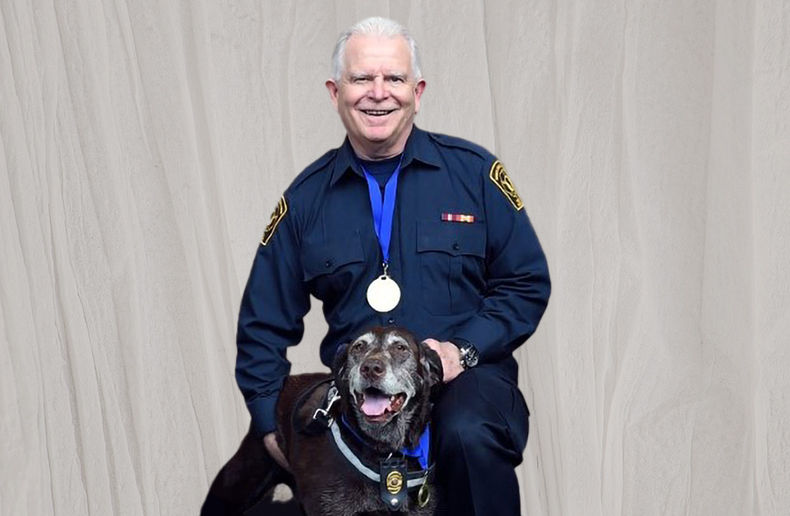
Michel Richer | Service détection canine Vesta
The last presenter at the conference Fraudexpert.ca was Michel Richer, former chief of the Sherbrooke fire department, instructor at the École nationale des pompiers du Québec (Quebec National Fire Academy), and founder of Vesta Prévention Incendie. He was the first fire investigator in Quebec to use a dog to detect the presence of an accelerant at a fire scene.
Richer has been to more than 575 fire scenes in Quebec and Ontario. The first two dogs that accompanied him, Vesta and Hestia, were honored by the Association des médecins vétérinaires du Québec (Quebec Veterinary Medical Association) and are part of the Panthéon québécois des animaux (Quebec Animal Hall of Fame) “professional” category. Since 2022, the investigator has been accompanied by Roxy, a chocolate Labrador.
Since his dog's presence at fire scenes attracted attention, media coverage of his work “helped reduce the number of arson fires in the Sherbrooke area,” says Richer.
Only one in 10 dogs passes the test required to become a detection specialist. Richer explains that it takes him 9 to 12 months to train a dog to detect accelerants. The animal can then work for 7 to 8 years and retire at the age of 9 or 10.
With the help of the dog, the investigator can more quickly determine the cause of the fire, eliminate false leads, and find pieces to be analyzed in the laboratory. “The dog is an aid to the investigation,” he says.
The danger of cross-contamination is the main obstacle facing the investigator and his dog. “People who were at the scene before you, such as the electrician who came to cut off the power, may have walked through the debris and contaminated the area,” explains Richer. In addition, some of the tools used by firefighters run on fuel, and the tanks are not always filled off-site.