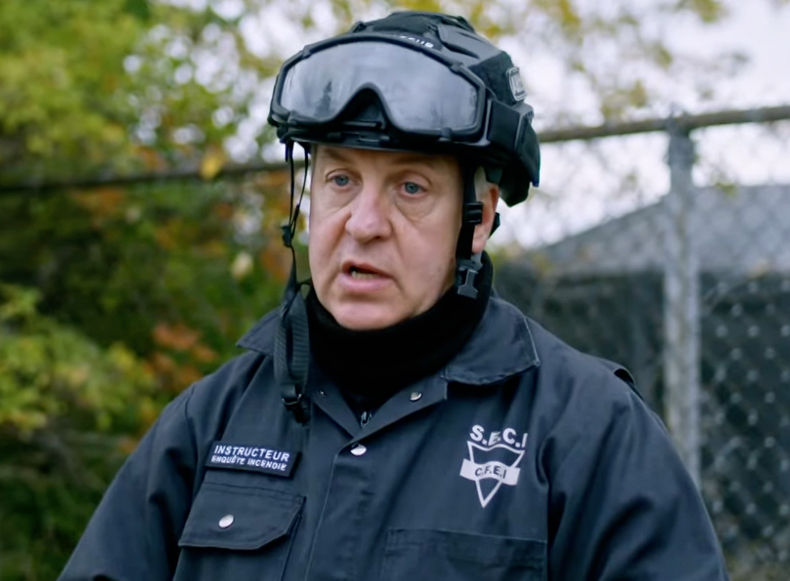
When there is a fire in a building and a claim is filed, the professionals analyzing the case must work with great rigor to determine the origin and cause of the loss. Sometimes, the loss is associated with fraudulent intent, and the claims adjuster's file must be expanded to meet the standard required by the courts, explains Alain Harvey, president of Groupe Arson.

On November 12, the 6th edition of the Congrès sur la détection des fraudes en assurance (Conference on Insurance Fraud Detection), organized by Fraudeexpert.ca (Groupe Arson), was held in Bécancour, Quebec. The Insurance Portal was able to attend.
Alain Harvey is the outgoing president of the Quebec chapter of the International Association of Arson Investigators. He holds various certifications that allow him to offer the National Association of Financial Investigators (NAFI) fire investigator course, which leads to the Certified Fire and Explosion Investigator (CFEI) diploma.
Specializing in arson investigation, he began his career as a police officer and also served with the United Nations (UN) Peacekeeping forces. His group received the Nobel Peace Prize in 1988. He has been the editor of numerous specialized magazines related to crime fighting and prevention.
Author of a book on the scientific method associated with fire investigation, Harvey is preparing another book on interviewing, which is scheduled for release in 2026. Co-founder of Fraudeexpert.ca, he was also featured in the series Enquêtes Incendies (Fire Investigations) broadcast on Canal D starting in 2021. The 16 episodes can be found on the Noovo channel's website.
Identifying the source of the fire
“The place where there is the most damage is not necessarily where the fire started,” says Harvey. The heat load associated with the contents of a room can help fuel the fire, and oxygen supply is another contributing factor to watch out for.
He suggests that loss adjusters be wary of reports that indicate the locations with the highest and lowest rates of charring. "The first rule in fire investigation is to identify the area where the fire started. If you haven't pinpointed that, you'll never be able to determine the cause of the fire," he emphasizes. It is therefore wrong to associate the origin of the fire with the most charred area.
Opportunity

Fraud is usually premeditated, but it can also arise from an opportunity that presents itself, according to Harvey. In the latter case, the most classic example is an exaggerated claim for the contents of a building following a disaster. Suspicious injuries that do not heal are also very common in disability insurance, confirms his colleague Guy Bérubé.
It is not always easy to prove fraud, says Harvey. Participants in the audience mention lack of evidence, time, willingness, and inadequate investigative tools as possible explanations for the difficulty in detecting fraudsters. “The element of intent that confirms the offense remains the most difficult piece of evidence to establish,” notes Harvey.
Due to time constraints, investigations are conducted remotely or by telephone, which is not recommended in cases involving major losses. The adjuster must visit the site and make his own observations at the scene of the loss. Otherwise, he must rely on physical evidence collected by others, and the file may be incomplete.
Claims adjusters are often afraid of confronting the insured, or even of contradicting a colleague or other professional who does not believe they will be able to prove fraud in court, adds Alain Harvey.
Proving intent
A false statement is generally an indicator of bad faith. He gives the example of an insured's statement describing the circumstances of a fire, which does not correspond to the facts established by the investigation.
Harvey cites the case of a dairy farmer who was going to find himself alone due to his father's retirement. Faced with the glaring contradictions in his testimony, he finally admitted that the fire that had ravaged the farm would enable him to purchase milking robots and maintain production even though he would be left alone to manage the farm.
In criminal law, it is necessary to link the damage to dishonest intent in order to obtain a conviction. Was a fire started by a cigarette accidental due to negligence? Or was it deliberate? To prove fraud, interviews must be conducted with witnesses. An expert who has not been trained in this area may conduct the interview poorly.
“I always start with the same sentence: tell me in your own words what you know about the event. After that, I work from what the person tells me,” explains Harvey. The witness's version can then be compared with those of others. Investigative interviews should never be conducted in tandem; the insured person should be interviewed separately from other family members.
The elements of the incident may lead the investigator to suspect fraud, but the only way to prove dishonest intent is to conduct interviews and listen to the witnesses' accounts of the incident, underlines Alain Harvey.
A scientific method
The NFPA 921 standard of the National Fire Protection Association (NFPA) in the United States lists the rules to be followed during a fire investigation. Sometimes the building has been demolished with a bulldozer and the expert arrives on the scene afterwards.
“If the first thing the expert does is head for the electrical panel, ask yourself some questions,” says Harvey. Some experts are even reluctant to rule out electrical failure when they have not found the cause of the fire.
In a case he worked on with Bérubé, photos taken by witnesses showed the early stages of the fire. Despite this, the engineer maintained the possibility of an electrical failure, without establishing any proof. “Court precedent is clear: the origin of the fire must first be found before its cause can be determined,” says Harvey. The origin of a fire can be determined based on the testimony of someone who was present and saw the fire start.
If the origin cannot be established, NFPA 921 states that the entire building may be considered the fire origin area. Fire kinetics, i.e., how the fire spreads, is part of the investigator's methodological approach. Possible sources of ignition must be identified and the investigator can eliminate them as the investigation progresses.
A burned-out vehicle that is inspected after being towed to the impound lot will not reveal much. The investigator must go to the site where the fire occurred and look for evidence there. He even recounts an incident where he found a container of fuel left near the scene of the fire. “The scene of the fire speaks for itself,” he says.
The motive behind the fraudulent act is usually financial. But proving motive is not easy either, according to Harvey. “If you ask a suspect why they committed the crime, they often won't say because they are ashamed. They admit to committing the act but refuse to say why.” Investigating the motive provides a better understanding of the reasoning that led the person with dishonest intentions to commit the act.
Level of certainty
All too often, there are cases where the experts' findings do not allow a conclusion to be drawn about the cause of a fire. The professional who analyzes a fire scene must only determine whether it was arson. They are not responsible for interviewing witnesses; that is not their mandate, but rather that of the loss adjuster, according to Harvey and Bérubé.
“The right mandate must be given to the right expert,” says Alain Harvey. An indeterminate conclusion is not very useful to the insurer. The author of the report must be able to distinguish between possibility and probability. NFPA 921 specifies the difference between the two.
If there are two hypotheses, but one of them is more probable, the expert can give preference to that one. It is quite rare for two hypotheses to have the same level of certainty, according to Alain Harvey. “If you have followed the NFPA 921 standard method, you cannot arrive at a result like that,” he says.
Facts cannot be eliminated because they do not correspond to the opinion that the expert formed during their investigation. “Facts can exonerate the suspect we had in mind. We have to say so in our report. It will be up to the court to determine their probative value,” he says.
For any type of fraud, if the claims adjuster can list the relevant facts and establish their significance in the context of the claim, their report will receive the attention it deserves. “We are there to advise the insurer's attorney and the court on the decision to be made,” he says.
“If the opinion is based solely on suspicion, it's not expertise. That's written in black and white in the NFPA standard,” regardless of whether it comes from a firefighter, police officer, or investigator, Harvey continues.
Any hypothesis that cannot be verified by facts or analysis has no place in an expert report. “Assumptions, sentences that begin with ‘I think that...’ have no place in an expert report,” he says.
Interviewing techniques
The rest of his presentation focused on the deductive process that begins with a first photo, followed by several others, leading to a hypothesis about the cause of a loss.
The goal was to conduct an investigation and interview witnesses to better understand what the scene of the loss tells us. Claims adjusters need to improve their interviewing techniques, he concluded.