
Europe is the fastest-warming continent in the world, report the World Meteorological Organization (WMO) and the European Centre for Medium-Range Weather Forecasts (ECMWF) in their annual report European State of the Climate 2025. This distinction has translated into a series of records that go far beyond anecdotal evidence.
Published on April 29, 2026, the report provides an overview of major changes in the continent’s climate indicators. The data were compiled by around a hundred scientists.
For the insurance industry, the report reads like a catalogue of structural trends already shaping—and set to further shape—the fundamental parameters of risk: frequency, severity, and accumulation.
A continent repeatedly breaking records
At least 95% of Europe recorded above-average annual temperatures in 2025, the report’s authors note. As a result, the number of winter days with freezing temperatures is shrinking. In subarctic Fennoscandia, a heatwave lasted three consecutive weeks in July—the longest ever recorded in the region—with temperatures approaching or exceeding 30°C within the Arctic Circle, peaking at 34.9°C in Frosta, Norway.
Snow and ice cover were directly affected by these temperatures. Combined with below-average precipitation in many areas, this led to a significant loss of snow and ice cover. In March 2025, Europe’s snow-covered area was about 31% below the average observed since 1983. Glaciers also experienced a net loss of mass, the report notes.
Scientists emphasize that snow and ice cover play a major role in climate regulation. They reflect sunlight back into space—a phenomenon known as the albedo effect. Without this white surface, temperatures on Earth rise.
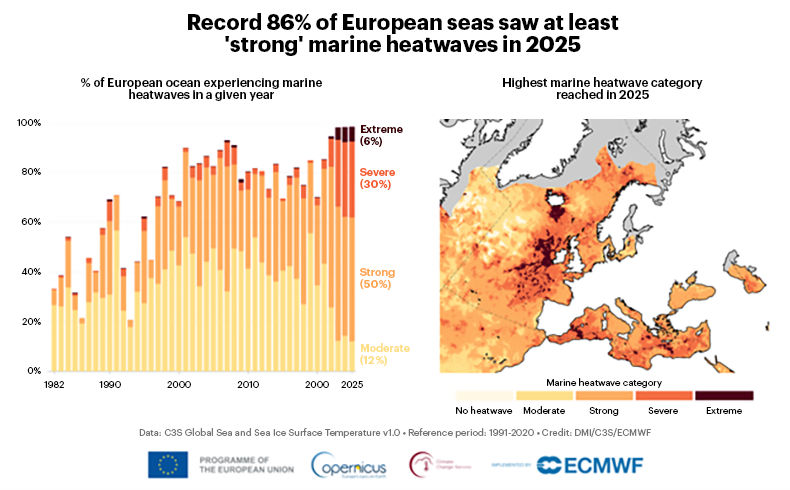
Regarding oceans, the annual sea surface temperature for the European region reached its highest level ever recorded, marking the fourth consecutive year of records, the report states. As a result, 86% of the oceanic region was affected by marine heatwaves, with 36% classified as “severe” or “extreme”—the highest proportion ever recorded, researchers report.
These combined conditions have contributed to rising global sea levels. Researchers estimate that each additional centimeter of sea-level rise exposes six million more people to coastal flooding.
Wildfires, droughts, floods: losses are accumulating
On the hydrological front, about 70% of European rivers recorded below-average flows, and in May 2025, nearly 53% of the continent was affected by drought, scientists report. This occurred in a context where 2025 ranked among the three driest years for soil moisture since 1992.
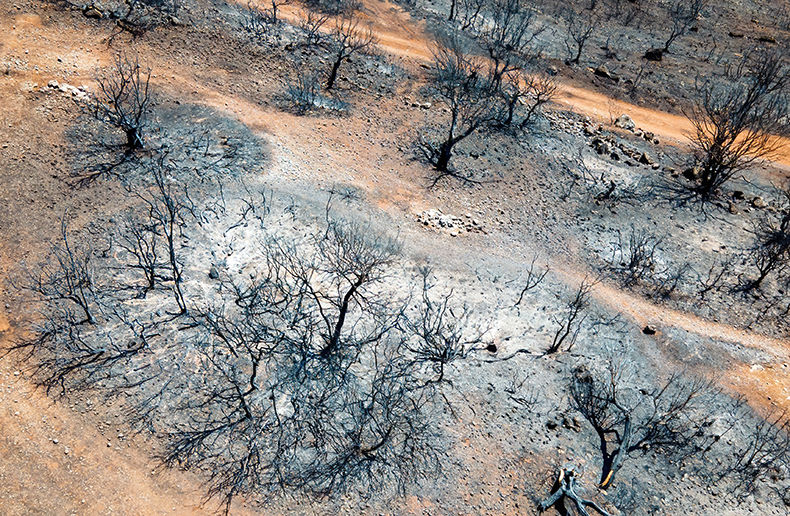
Wildfires burned approximately 1,034,550 hectares in 2025—the largest area ever recorded in Europe—an expanse larger than the island of Cyprus. Spain was particularly affected, accounting for nearly half of wildfire-related emissions. The United Kingdom, the Netherlands, and Germany also recorded their highest wildfire emissions.
The report notes, however, that extreme precipitation and flooding were less widespread than in recent years, representing the main positive nuance in the 2025 assessment.
Samantha Burgess, Strategic Lead for Climate at the ECMWF, was unequivocal in the press release: “climate change is not a future threat, it is our present reality.”
The 2025 report reinforces several well-documented warning signals: longer risk seasons, geographic expansion of exposed areas, and, critically, a gradual break from the historical data on which pricing models are based.
A relatively recent phenomenon at the global scale is likely to intensify: wildfires. In Europe, researchers say they pose a significant risk to biodiversity, particularly through peat fires. These can release large carbon reserves, further amplifying climate change.
The European Commission has identified the growing risk of wildfires as a major priority. This aligns with observations from other scientists who believe wildfire threats are likely to increase across all regions of Europe.
The phenomenon has also been intensifying in North America.
Serge Therrien
President and Publisher
Insurance Journal Publishing Group