

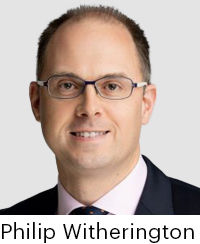
Phil Witherington says the first year of his tenure as president and CEO of Manulife has been action-packed. Milestones reached include the release of a refreshed enterprise strategy, entry into India’s life insurance market and the completion of the company’s largest acquisition in a decade when it acquired Comvest Credit Partners.
“There’s much more that this management team wants to deliver,” he told the group of investors and asset managers gathered at the Scotiabank Financials Summit on Sept. 10.
The company’s Asian business was discussed much of the time, performance in its global wealth and asset management division has come back following a slight dip in the first quarter of 2026 and the company’s capital position remains strong, suggesting the possibility for additional mergers and acquisitions in the future.
“Organic capital deployment is always our highest priority. Supporting a progressive dividend is also up there as a high priority – 2.5 per cent share buyback program in place. We’re on track to deliver on that,” Witherington told those gathered. “But inorganic development (acquisitions), yes, that’s possible. I think we’ve demonstrated through the largest acquisition in a decade with Comvest Credit Partners that we’re prepared to do that. When we’ve done that (however), it’s a transaction that’s financially accretive and strategically relevant.”
According to the CEO, Comvest is already a material contributor to the net flows of the organization, contributing approximately $30 million to core earnings in the second quarter of 2026. Witherington says the company is also an important contributor to Manulife’s institutional net flows.
“Comvest was a great acquisition. The business is thriving as part of Manulife,” he adds.
As for future deals, he adds that the Manulife likes global wealth and asset management as a place to deploy capital. “We like the fee income and the diversification that provides, but we do look for financial accretion and strategic accretion. It’s not really about bolt-ons or larger transactions, it’s much more about whether there is the right transaction that delivers against those criteria,” he added. “But we have the capability to move, and we’ve got the financial strength to move if there is the right opportunity.”
Eyes on Asia
According to Witherington, Asia is a key driver of the business’ growth. “It’s driving strong, double-digit earnings growth, actually above 20 per cent,” he told those gathered, adding that he would typically expect slightly lower growth, “in the teens” for that segment. “We’ve seen very strong performance in our Asia business and it’s coming from multiple markets.”
Demand for the company’s products and services in insurance and retirement is driving new business growth, while regional financial centres on the world stage – Hong Kong and Singapore notably – are rising in standing as the world’s wealth managers. “Just this year, Hong Kong has overtaken Switzerland as the largest, cross-border wealth hub in the world. That’s an incredible milestone,” he notes.
Broken down, he says there is both strong domestic demand in Hong Kong but also 25 per cent of the demand they see coming from mainland Chinese visitors.
“Hong Kong is a very sophisticated insurance market,” he adds. Singapore is similarly noted for new business contractual service margin or CSM growth close to 40 per cent.
He also notes a third trend, that is third-party distribution channels in the region becoming more relevant. “It provides more access to a wider range of customer segments. I actually see that as a positive and a strategic opportunity.”
Future earnings
At a high-level Witherington says the company’s base scenario, where reported return on earnings is 18 per cent in 2027, remains intact but adds that there are certain headwinds that were not anticipated when that target was set. Among those headwinds, he notes the long-term disability experience in the company’s Canadian business, a weakening of the Canadian dollar relative to the U.S. dollar (“we have more capital in U.S. dollars,” he points out), while the company has seen some variability in the U.S. life experience, as well.
“To get to 18 per cent over the course of the next 12 to 18 months, it’s reasonable. I believe we can get there. It’s a base scenario,” he says. “We essentially need Asia and global wealth and asset management to continue to grow at mid-teens growth rates. We need to see a normalization of disability experience in Canada.”