
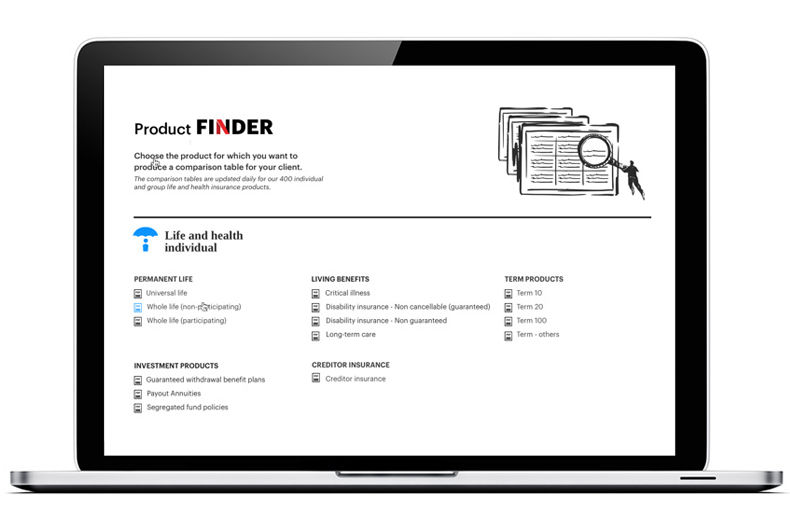
According to information available in the comparative table from InsuranceINTEL, the individual insurance product information centre published by the Insurance Journal Publishing Group, twelve insurers offer immediate annuities.
They are Assumption Life, BMO Insurance, Canada Life, Co-operators, Desjardins Insurance, Equitable, iA Financial Group, ivari, Manulife, RBC Insurance, Sun Life, and UV Insurance.
A popular decumulation tool in retirement planning, the immediate annuity is named for the income it provides as soon as a client purchases it from an insurer. Annuity payments are guaranteed by the insurer, and by Assuris in case of the insurer’s insolvency. The compensation organization for life and health insurance ensures a monthly income of up to $5,000, or 90 per cent of the guaranteed monthly income if it exceeds $5,000.
Insurers offer two main types of annuities:
- Life annuity: provides the annuitant with guaranteed income for life.
- Term certain annuity: also known as a fixed-term annuity, pays out over a set period. If the annuitant dies before the end of that period, payments continue to their estate or beneficiaries.
Indexing and tax benefits
Clients can protect their purchasing power in retirement by choosing an indexed annuity. Payments from this annuity generally increase at a fixed compound annual rate.
An annuity may offer greater advantages than a Registered Retirement Income Fund (RRIF) if purchased using non-registered funds instead of those from a Registered Retirement Savings Plan (RRSP), for example. Annuity payments funded with registered money are fully taxable. When the premium is paid with non-registered funds, only the interest portion of the annuity income is taxable. Taxes will be higher in the early years but will decrease over time as the interest-bearing capital declines.
A non-registered annuity may benefit from a specific tax treatment known as a prescribed annuity. In a document for advisors entitled Taxation of Non-Registered Prescribed Annuities, RBC Insurance outlines what this status entails. In a prescribed annuity, the payments consist of both capital and interest, with the interest portion taxed on a level basis spread evenly over the life of the annuity contract, the insurer explains.
To qualify as prescribed, a non-registered annuity must meet all of the conditions set out in Section 304 of the federal Income Tax Regulations, RBC Insurance points out. Among them: the policyholder must also be the annuitant and receive all payments. They must be an individual, a testamentary trust, or a specified trust unrelated to the annuity issuer. The guaranteed or fixed term of the payments must not extend beyond the annuitant’s 90th birthday.
Another advantage—this one applying to all types of annuities—is that one purchased at age 65 or older generally qualifies for the federal pension income tax credit and for pension income splitting.
Estate planning
Often referred to as a joint-life annuity, the survivor annuity benefits two annuitants. If one dies, the other continues to receive annuity payments. All insurers listed in InsuranceINTEL’s comparative annuity table offer this type.
Meanwhile, a capital guarantee option allows the annuitant’s heirs to receive a lump sum payment (cash refund). Canada Life, Desjardins Insurance, iA Financial Group and Manulife are the only insurers to offer this option. Manulife specifies that it only offers this capital guarantee with a life annuity.
A deeper search of the InsuranceINTEL product information centre reveals more details on capital guarantee payouts. The capital option takes effect at the start of annuity payments if selected beforehand. At Canada Life, it can be chosen with or without interest.
Desjardins Insurance and iA Financial Group explain that the capital guarantee is available with individual life annuities and joint annuities. They note that they will reimburse the difference between the premium and the total amount of annuity payments made.
Most insurers will reimburse the premium paid in exchange for the annuity if the annuitant dies before receiving the first payment. Only Co-operators and UV Insurance do not offer this guarantee. Among those who do, all will reimburse the premium if the annuitant dies before receiving the first annuity payment, according to a search of InsuranceINTEL’s database.
Assumption Life specifies that if the first payment is scheduled within 30 days of the annuity contract being issued and the annuitant dies beforehand, the premium will be refunded. Canada Life, iA Financial Group, and Manulife say they will refund the premium plus interest. iA specifies that upon the annuitant’s death, it will refund the premium plus 2 per cent. This guarantee is available for life annuities, joint annuities, and term certain annuities.
What does it look like in practice?
According to the calculator on Sun Life’s website, a 65-year-old man can expect to receive annual after-tax income of $20,255 from an annuity purchased with a $500,000 premium sourced from registered investments. The calculation assumes a 35 per cent tax rate and a 3 per cent interest rate. Under the same conditions, if the annuity is funded with non-registered assets, the annual after-tax income rises to $28,767.
Because women tend to live longer than men, the annuity amounts they receive are generally lower, as insurers plan for longer payment periods. Still using the $500,000 premium and the same assumptions as above, a woman would receive $19,265 from registered funds and $26,909 from non-registered funds.