
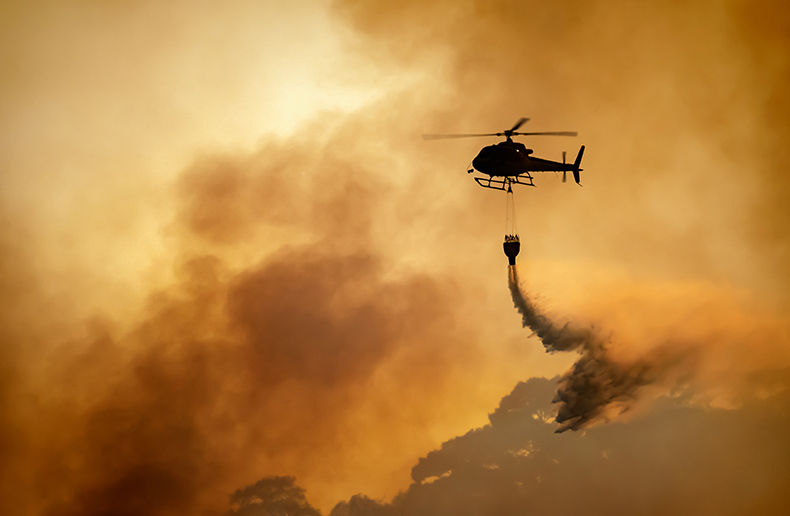
The strenuous workload of insurance firms across Canada has been further complicated by comprehensive new risk management requirements to account for the impact of severe climate events.
Guideline B-15: Climate Risk Management, issued by the Office of the Superintendent of Financial Institutions (OSFI) in 2023, requires all federally regulated financial institutions (FRFI) in Canada to demonstrate that institution “understands and mitigates against potential impacts of climate-related risks to its business model and strategy.”
Firms must also show they have “appropriate governance and risk management practices to manage identified climate-related risks.” And they must illustrate that they will remain “financially resilient through severe, yet plausible, climate risk scenarios, and operationally resilient through disruption due to climate-related disasters.”
Guideline B-15 was effective for domestically systemically important banks (DSIB) and internationally active insurance groups (IAIG) headquartered in Canada for their 2024 fiscal year end. It will become effective for all other FRFIs, except foreign bank branches, at their 2025 fiscal year end.
Since 2023, “the risk management expectations in Chapter 1 of Guideline B-15: Climate Risk Management have not changed,” says Cory Harding, an OSFI spokesperson.
“The only updates OSFI has made to the guideline are related to disclosure expectations in Chapter 2 that evolved after the guideline was first published. These updates reflect our commitment to ensuring our climate-related disclosure guidance remains interoperable with the International Sustainability Standards Board’s and Canadian Sustainability [Standards] Board’s final standards,” Harding explains.
Chapter 1 of Guideline B-15 covers governance and risk management expectations, and Chapter 2 is for climate-related financial disclosures.
OSFI news releases detail two adjustments. The first was made in 2024 to streamline climate disclosures and promote transparency of climate-related risks to align the expectations for FRFIs with the International Sustainability Standards Board’s final IFRS S2 – Climate Related Disclosures standard.
A second adjustment was made in 2025 to correspond with Canadian Sustainability Standards Board (CSSB) standards.
Key updates there include: “revising the implementation date for the expectation to disclose Scope 3 greenhouse gas emissions to align with the CSSB standards (fiscal year 2028); clarifying expectations for on-balance sheet and off-balance sheet assets under management; and setting the implementation date to disclose Scope 3 greenhouse gas emissions for the off-balance sheet component of assets under management to fiscal year 2029.”
“If you're a big publicly traded company you’re already doing a lot of these climate related disclosures,” says Mary Kelly, a professor and chair in insurance at Wilfrid Laurier University’s Lazaridis School of Business & Economics in Waterloo, Ont.
“But the smaller private insurers, [and] some of the mutual companies don't have the resources for this. It’s putting significant compliance costs on [them]. The impact is not even across the industry,” she adds.
Anthony Buonaiuto, a partner in finance transformation and national ESG transformation leader with KPMG in Canada in Toronto, says firms that have not yet started to prepare for Guideline B-15 have much work ahead.
They must be able to gather all of the data required by OSFI, categorize their climate risks in a structured way, determine the governance required at the board and management level, and then embed some of that into their enterprise risk management framework, he elaborates.
Forging closer relationships
Manulife is one of four insurers in Canada categorized as IAIGs, for whom Guideline B-15 is in effect.
“Like others, we’ve been monitoring, evaluating, and reporting climate risk to our business for several years, utilizing voluntary standards and guidance, such as the Task Force for Climate-related Financial Disclosures. Therefore, the impact has been mostly incremental, as opposed to requiring significant step change,” says Ariel Kangasniemi, environment, social and corporate governance managing director for Manulife in Toronto.
Kangasniemi notes that Guideline B-15 has led to further discussions and capacity building across Manulife. In particular, it has provided a closer partnership between sustainability and risk professionals, in terms of what climate risk is, and if and how it can be measured across the firm’s various risk categories.
It has also reinforced the efforts that were already underway to strengthen processes and controls for disclosures – thereby building greater discipline and rigor, she adds.
But Manulife has also had to make adjustments.
“Typically, we’ve focused disclosure on areas where we have a high degree of confidence and certainty in our data. B-15 has introduced increased expectations around quantification of climate-related risk, particularly as it relates to investment, where the risk is perceived as most measurable by regulators,” says Kangasniemi.
“As we work to meet these expectations, in alignment with our desire to ensure disclosures are robust and accurate, we’ve needed to accelerate tool procurement for climate risk assessment, engaging more directly with tool providers – of which there are many – to understand the benefits and limitations of each of their approaches. We’re particularly focused on physical climate risk,” she explains.
Kangasniemi adds that service providers are responding with improved tools to meet the demand arising from new regulations like Guideline B-15, “though we see value in leveraging these tools beyond simply meeting regulatory requirements.”
She notes that as a life and health insurer, the ability of Manulife to measure direct impacts of climate-related risks on insured populations is still highly limited, and dependent on factors such as geographic concentration of risk, availability of robust claims data, and scientific grounding in mortality and morbidity impacts.
Guideline B-15 has, therefore, had limited impact on Manulife’s current underwriting approach, although efforts are underway to investigate further these impacts within the company’s product and risk underwriting function, Kangasniemi elaborates.
“Similarly, B-15 isn’t directly influencing our approach on risk pricing or modelling yet, though we anticipate that efforts to strategically integrate climate-related factors into investments made by our General Account may surface relevant risks and opportunities on the assets side of the profitability equation,” she adds.
Kangasniemi says that Guideline B-15 was issued when jurisdictions outside Canada either already have or are implementing similar climate risk requirements, and so Manulife has needed to increasingly work at both a regional and global level to ensure it is expanding its disclosures to meet a variety of regulatory requirements, beyond those of OSFI.
Longer-term planning
Houston Cheng, a property and casualty (P&C) actuarial partner with KPMG in Canada in Toronto, says that many P&C companies in Canada have already been looking at severe weather events to manage their climate risk, understanding how this has the potential to increase catastrophic losses to the policies they insure.
However, what OSFI is asking for can be a little bit different from a risk management perspective, he explains. “OSFI is asking for documentation of what you're doing and why what you're doing is sufficient, but also potentially looking at risk and opportunities [over] the medium and long term, and that's where I think there is some impact to the industry’s approach to looking at climate risk,” he explains.
While insurance firms are good at assessing their short-term capital needs in terms of, for example, setting premiums and establishing reserves, many have not extended their horizon out over the medium and long term, which could extend to ten years and beyond. And so, Guideline B-15 will have an impact because it will require some new perspectives, new modeling, and a new way of understanding those results, Cheng elaborates.
Mary Kelly says that a central issue with OSFI’s climate risk guideline is that it does not distinguish meaningfully between different types of financial institutions.
“P&C insurers are being held to the same disclosure and transition-planning requirements as banks and life insurers, even though their risk profiles are very different,” she says. “P&C insurers operate on one-year contracts, which allows them to reprice and adjust underwriting quickly. Their exposure is to physical risks such as flood and wildfire, not to long-dated transition risks like 30-year mortgages or pension liabilities.”
Requiring them to measure insurance-associated emissions and publish long-term transition plans creates a misalignment between their regulatory burden and the actual risks they manage, Kelly adds.
Furthermore, she notes, climate risk does not flow directly through the Minimum Capital Test.
“While there are capital charges for insurance risks such as catastrophes, there is no explicit capital charge for climate risk. That means this guideline is entirely about reporting and disclosure, not about capital adequacy. In practice, it risks becoming a costly compliance exercise rather than a prudential requirement that strengthens resilience,” Kelly says.
Anthony Buonaiuto believes there are potential long-term advantages offered by Guideline B-15.
The insurance firms that are able to gather quality data around climate risks and opportunities, and then use that data to make both better business decisions, and more informed strategic decisions, will have an advantage in terms of being able to price their products better, and move into different markets to design products that their customers need, he predicts.
Geosapiens offers insurers flood, wildlife risk modelling
Geosapiens Inc., based in Quebec City, specializes in both flood risk and wildlife risk modelling. The firm, founded in 2017, initially produced Canada-wide flood risk modelling to cover fluvial (river), pluvial and coastal flooding.

Both the flood and wildfire risk modelling impacts Canadian financial service firm requirements under new OSFI Guideline B-15: Climate Risk Management. For insurance companies in particular, this helps allow for improved underwriting precision, enhanced catastrophe modeling and smarter risk pricing, says Hachem Agili, chief executive officer and co-founder of Geosapiens.
Geosapiens and Revau Advanced Underwriting Inc., a managing general agent (MGA) headquartered in Terrebonne, Quebec, specializing in P&C insurance, recently announced the signing of a mutual long-term strategic agreement. Through this partnership, Revau will integrate Geosapiens’ advanced flood and wildlife risk models into its proprietary technology platform “to enhance risk management on a national scale.”
A key catalyst for starting Geosapiens was a recognition that companies were unprepared for major flood events, such as the one in Calgary in 2013 that caused about $6 billion in losses, says Agili.
“We [saw] after this and other events, a huge gap in the market in terms of data availability and data accuracy [to be able] to assess the risk and be more prepared, especially [with] the increase of frequency and the severity of these climate events,” he elaborates.
Geosapiens expanded into wildfire risk modelling in 2025, realizing that companies were also lacking data, particularly in a Canadian context, to prepare for historically bad years, such as in 2023, when about 18 million hectares across Canada burned in wildfires, causing billions of dollars worth of damage.
Geosapiens’ wildlife risk model integrates four major categories – climate, vegetation, topography and human factors.
“Our model provides granular risk insights on wildfire so it provides a risk score at the property level. This information is key for insurance companies to quantify, manage, price, and also disclose the wildfire risk for regulatory purposes,” Agili explains.