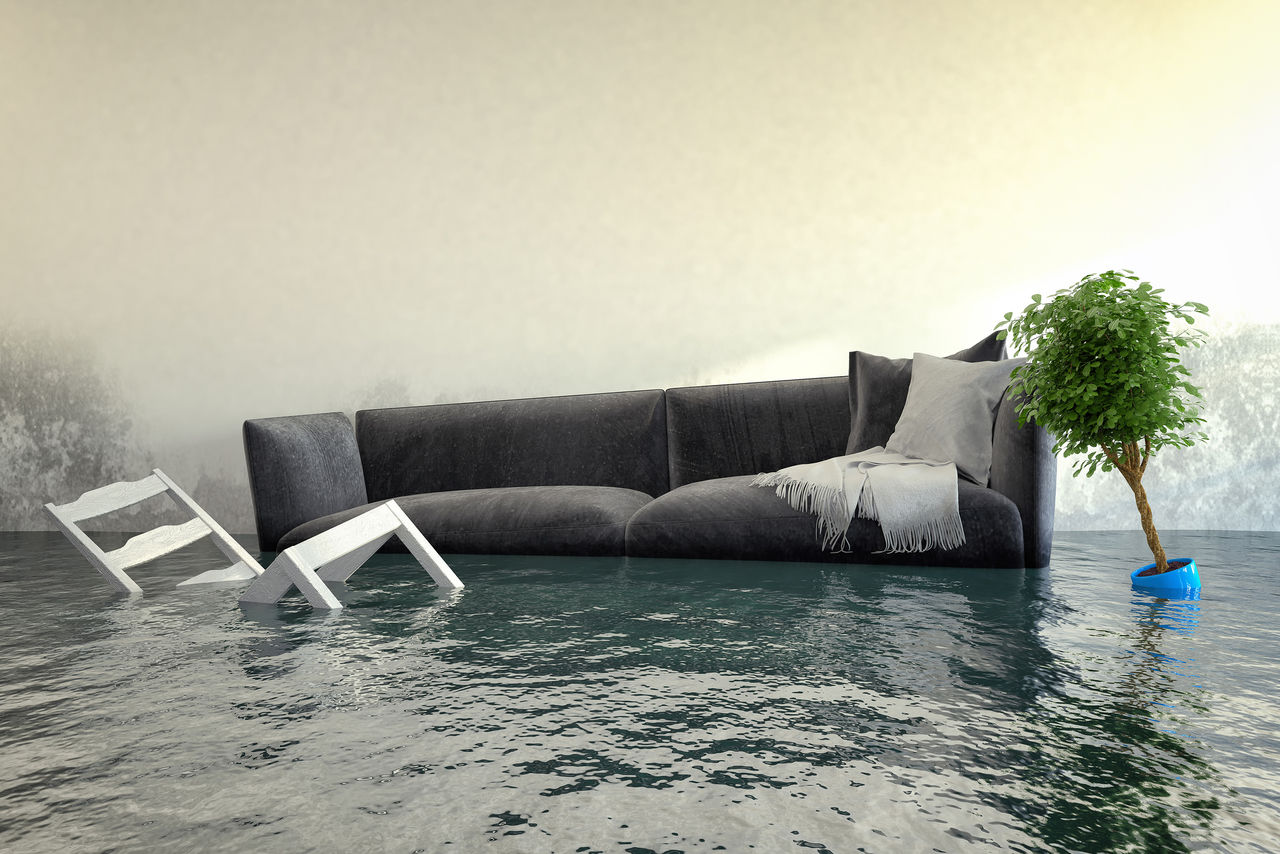
“Even today, post-disaster techniques and methods are stuck in the past,” laments Charles-François Richard. “The ways of managing water damage have remained the same. This generates a lot of waste in terms of time, money, and also waste.”
In an interview with the Insurance Portal, Richard, who is a partner and CFO of Assek Technologies states that although his company is still almost alone in its field in Quebec, it is because it is challenging the prevailing rules in the industry.
This cleaning company based in the Quebec City area has developed a system that dries the inside of walls without completely opening them up, thus limiting or even eliminating demolition work in the event of water damage.
“Our competitors generally have a business model based on demolition,” says Richard. “They have their license [from the Régie du bâtiment du Québec (RBQ)] and that’s how they make their money. For them, [adopting our method] would be a complete 180-degree turn in their business model.”
According to figures from Recyc-Québec for 2023, approximately 1.075 million tonnes of waste sent to landfills came from the construction sector.
Targeted treatment
“Contrary to popular belief, if the intervention is carried out in time, it’s possible to dry out the materials and prevent the presence of contaminants and mold,” explains Charles-François Richard.
In an ideal situation, this timeframe is about seven to ten days, he says, but for older buildings, it’s shorter. “In some cases, three days later is too late,” he says. “But we come out on day one.”
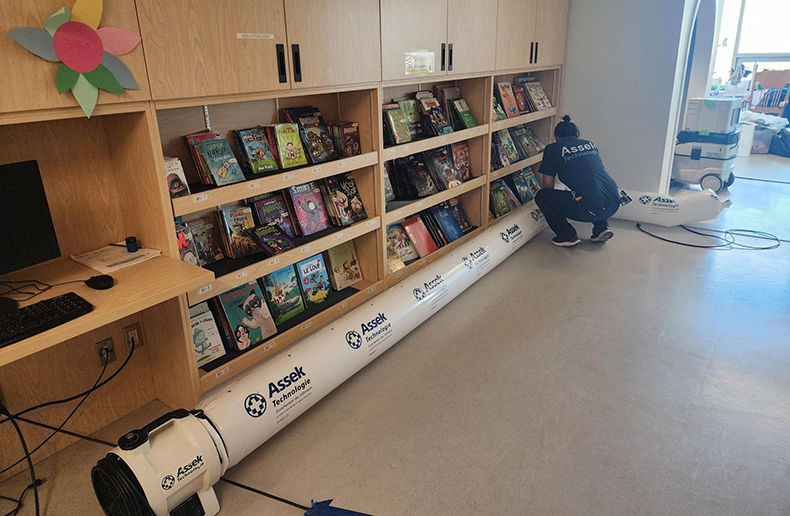
The company, which has just over twenty employees, offers targeted treatment for wet and damp areas. It has patented its Secur technology, which consists of a drying system that injects air into the walls.
Specifically, Assek’s technicians remove the moldings at the base of the walls and drill holes in them to install injection pipes through which heated and dehumidified air is forced to dry the structure from the inside. “Air follows the same path as water before it,” explains Richard.
Depending on the extent of the damage and the type of material, the drying process takes an average of three to four days.
At the same time, the company uses point sensors and thermographic imaging to confirm the presence of moisture. Afterward, before sealing the holes made at the base of the walls with fire-resistant drywall washers, microbiological samples are taken for analysis to ensure that no mold has had time to develop.
Nine years of testing
From 2008 to 2017, the company enlisted the expertise of Clemente Ibarra Castanedo, who works at the Computer Vision and Systems Laboratory of the Faculty of Science and Engineering at Université Laval.
For nine years, numerous tests were conducted, both in the laboratory and on disaster sites, to find "the formula that works for each situation," namely the air temperature, the drying time, and the other parameters that make the operation optimal, explains Ibarra Castanedo in an interview.
"It's easy to say 'we'll inject air,' but you have to find the right equipment, the type of pipe to use, the type of device to push the air, and the heating system," the researcher specifies.
Some of the progress came about intuitively, he notes. "The technicians knew what they were doing [in the field]. They would arrive at a damp area that they would heat first before venting the air, without necessarily knowing when to start heating, when to stop, and when to circulate the air," explains Ibarra Castanedo. We took the data in the lab and our tests were used to optimize these parameters.
Ecological and economical
By reducing demolition work, this approach helps decrease the volume of waste generated after a disaster. The company also states that it uses recyclable materials for its equipment.
"Our only environmental impact is the electricity consumed and the travel of our teams and equipment," summarizes Charles-François Richard.
Assek also claims to save its clients a significant amount of money, particularly because they can continue their operations during the demolition and because they don't have to pay for a complete demolition and reconstruction.