According to a study released on August 6 by World Weather Attribution (WWA), the defining feature of Canada’s 2026 wildfire season is the vast extent of burned areas and the rapid spread of fires over a very short period.
Researchers from Canada, the United States, the United Kingdom and the Netherlands confirm that human-induced climate change has more than doubled the likelihood of the extreme weather conditions behind these wildfires. They believe these factors will become even more pronounced as global average temperatures continue to rise in the coming years.
In addition to the thousands of people forced to flee the flames, wildfire smoke travels over long distances and affects the health of the most vulnerable populations, WWA notes.
Favourable conditions
About 94 per cent of the burned area was recorded over a five-week period from late June to late July. The wildfire season first intensified in the Northwest Territories and British Columbia, with fires of comparable intensity to those seen in 2014 and 2023.
Beginning in mid-July, fires spread across northwestern Ontario, fueled by extreme heat, drought and strong winds. During the week of July 20, numerous thunderstorms ignited new fires across Ontario.
As of the end of the day on August 4, 2026, the area burned by the 4,482 wildfires across Canada had reached 3,852,595 hectares, according to data from the Canadian Interagency Forest Fire Centre (CIFFC). At that point, 699 fires remained active, and conditions continued to worsen due to the heat and winds affecting British Columbia. In that province, where the fire danger was classified as extreme, six fires were designated as priority incidents by the CIFFC.
After a relatively quiet spring, the arrival of summer significantly worsened conditions in Ontario and Quebec. In mid-July, more than 500,000 hectares had burned in Ontario over a two-day period. Over the past three weeks, fires mainly affected the Northwest Territories, where more than one million hectares burned, and British Columbia.
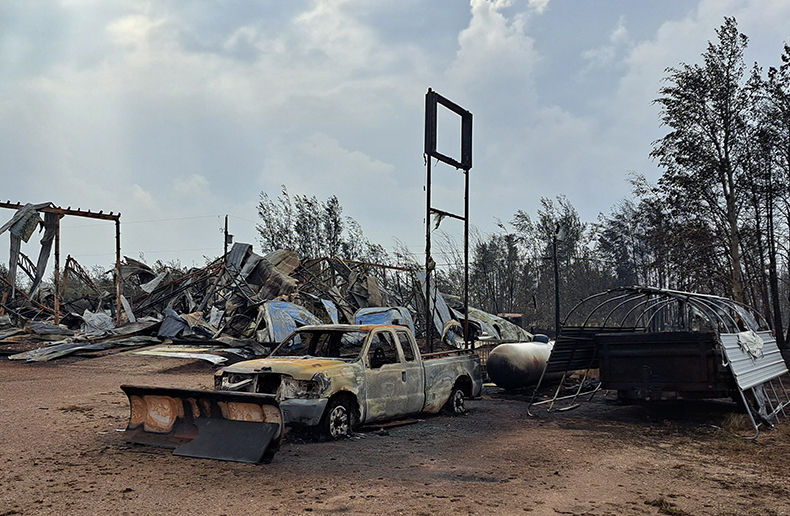
The insured loss tally could continue to climb, as numerous communities have been evacuated and many structures and buildings have been destroyed by the flames.
Severity indices
The Daily Severity Rating (DSR) is used alongside the Canadian Fire Weather Index (FWI), the index used by emergency management authorities to warn the public when wildfire danger reaches high or extreme levels. When prolonged heat and lack of precipitation combine with strong winds, authorities must detect and suppress fires quickly before they grow out of control.
As part of the study, WWA researchers analyzed changes in the seven-day severity index (DSR7x) and the 30-day severity index (DSR30x). In the Northwest Territories, the DSR30x recorded in July had a return period of six years. Under temperatures that were 1.4 °C lower—equivalent to the increase in global average temperature since the industrial era—the DSR30x in the territory would instead have a return period of 100 years.
Also in the Northwest Territories, the DSR7x observed in July has a two-year return period, whereas it would have a 50-year return period if average temperatures matched pre-industrial conditions.
In Ontario, the extremely rapid spread of the fires means the DSR7x is more relevant, with a return period of 15 years, making such conditions 3.5 times more likely than under a global climate that was 1.4 °C cooler.
Another factor
Beyond the weather conditions present when fires ignite, WWA also examined effective precipitation over the preceding two-year period. The observations show that changes in effective precipitation intensity compared with a climate that was 1.4 °C cooler are small and highly uncertain in both regions.
“There is no evident trend in the climate models; thus, we cannot attribute a change in 24-month dry conditions to human-induced climate change. This lack of a trend in long-term drought does not necessarily apply to the rapid onset of drought at shorter timescales, which is included as a factor in the drought code component of the DSR,” the researchers add.
This marks the fourth consecutive year in which Canada has experienced an above-average wildfire season. In 2023, WWA’s analysis of Quebec’s exceptionally early wildfire season concluded that such an event was seven times more likely because of rising global average temperatures.
A long and intense wildfire season has numerous negative consequences, the researchers note. “Indigenous communities and wildland firefighters face heightened physical and mental health impacts from wildfires. Indigenous communities are overrepresented in wildfire-affected areas, while remote locations and limited transportation routes have made evacuations more difficult. Successive wildfires have made long-term recovery between disasters more difficult. Beyond physical impacts, repeated evacuations and displacement can disrupt access to hunting grounds, traditional foods and cultural practices,” the study’s key findings state.
According to Friederike Otto, a climate scientist and professor at the Grantham Institute’s Centre for Environmental Policy at Imperial College London, “we have seen repeatedly how climate change increases hot, dry and flammable conditions that are extremely conducive to wildfires. This time, we studied Canada for the second time in three years. Less than a week ago, we looked at France and Spain. A few months ago, we were looking at Chile and Argentina. What is going to be next?” she says.
Otto adds: “Time and again, we see the same results. Climate change is a key driver behind uncontrollably large and unprecedented fires. This shouldn’t come as a surprise. The science has been clear for decades: burning fossil fuels is making these wildfires more frequent, more intense and more difficult to contain.”
Concerns
During the webinar held for journalists before the study’s release, Jonathan Boucher of the Canadian Forest Service (CFS) at Natural Resources Canada noted that Canada’s boreal forests are publicly owned and that fires are not actively suppressed across vast portions of the territory because fire is a natural part of the ecosystem and contributes to the regeneration of various tree species.
During the question period, Insurance Portal pointed out that the ongoing fires in British Columbia are forcing the evacuation of more densely populated communities. “Any wildfire near communities (in the wildland-urban interface) is a cause for concern. We have also seen in recent years fires in less prone areas in Atlantic Canada, destroying houses and leading to evacuations,” Boucher replied.
Regarding these urbanized areas bordering public lands, known as the wildland-urban interface (WUI), WWA cites several studies estimating that 13 per cent of Canada’s population lives in these areas. Nearly one-third of those residents (32 per cent) living in WUI zones are members of First Nations communities on reserve. About 19 per cent of the population living on reserves faces significant wildfire risk.
WWA stresses that warning and evacuation systems must be improved. The need was evident on July 13 in the region north of Thunder Bay, Ontario. At 2:30 p.m. that day, Lawrence Wanakamik, Chief of Whitesand First Nation, asked the Ontario government to monitor a new fire near Mathias Lake.
At 4:30 p.m., Ontario’s Ministry of Natural Resources indicated there was no cause for concern. As a large smoke plume approached, however, the community began evacuating more than five hours before emergency officials issued an official evacuation order. In Namaygoosisagagun (Collins), no warning had been issued, and residents were forced to flee their village by boat after it had already been surrounded by fire.
At Fort Simpson, Northwest Territories, on July 19, the Fire Weather Index reached the most extreme level ever recorded on any July day in the territory since 1990, participants heard during the webinar.
CBC journalist Niles Niemuth, who is based in Yellowknife, noted that more than 20,000 people were evacuated during the 2023 wildfires and that the event caused significant trauma among residents. This explains the significant stress resulting from the fires currently burning in the region, he says.