Media coverage of extreme heat events needs to be revised, according to several experts. If the goal is to better inform the public about the impacts of this extreme weather on human health and the economy, it is necessary to remind people that rising daytime and nighttime temperatures are a direct consequence of fossil fuel consumption.
The organization Covering Climate Now hosted the webinar, entitled Deadly Heat, Vital Reporting, on June 30. The event is easy to find on the organization’s YouTube channel, which helps journalists and media outlets better inform their communities about the impacts of climate change.
If nothing is done to stop greenhouse gas (GHG) emissions linked to the consumption of oil, gas and coal, “what scares me the most this will be the coolest summer for the rest of our lives,” says Patrick Galey, fossil fuels investigations lead at the non-profit organization Global Witness and a former journalist with Agence France-Presse (AFP).
In the United Kingdom, where he lives and where temperatures exceeded 30 °C at the end of May, only 3% of buildings are designed to reduce the impact of outdoor heat. “Of course, we could retrofit every home and business here and elsewhere in Europe and equip them with air conditioning. But that is not what climate adaptation is,” says Galey.
“If we are trying to solve a problem, the first thing to do is stop making it worse,” he continues. Since the Paris Agreement on climate was signed in 2015, GHG emissions have continued to increase every year, except in 2020 because of the COVID-19 pandemic, says Galey.
Heat, the silent killer
Jeff Goodell is an author and contributing editor at Rolling Stone. In 2023, he published the book The Heat Will Kill You First: Life and Death on a Scorch Planet. In its prologue, readers learn more about the weather conditions that led to the wildfire that destroyed Lytton, British Columbia, in 2021. A heat dome had settled over the Pacific Northwest for several days.
Goodell cites measurements taken by Vivek Shandas, a professor of urban studies at Portland State University in Oregon, who regularly drives through the city to record outdoor temperatures in different neighbourhoods. In late June 2021, in Lents, one of the poorest neighbourhoods in the metropolitan area where trees are few and far between, Shandas recorded a temperature of 124 °F (51.1 °C), the highest he had ever measured.
About 15 kilometres away, in the affluent neighbourhood of Willamette Heights, where there are parks and abundant vegetation, the temperature reached 99 °F (37.2 °C) on the same day. “In a heat wave, wealth can afford twenty-five degrees of coolness,” Goodell writes.
During the webinar, the author shared a personal story that awakened him to the dangers of extreme heat. While reporting in Phoenix, Arizona, he realized he was going to be late for an appointment. Instead of calling an Uber driver, Goodell decided to run the distance, about seven city blocks through a downtown core dominated by concrete, asphalt, glass and steel. Halfway there, he stopped, dizzy and confused, because the heat had become unbearable.
“I had been covering climate change for about 15 years. It took me all that time to truly understand the threat posed by extreme heat,” he says. It illustrates just how difficult it is to describe the phenomenon properly.
“When I wrote my book, it was like writing the biography of a ghost. When there is a storm or a hurricane, you can describe the damage and the victims. Heat is invisible. If I look out the window, I cannot tell what the temperature is outside. The people who suffer from it are working outdoors or in enclosed, poorly ventilated spaces,” he says.
“When someone dies because of heat, there is no explosion,” he adds. “The person is often alone at home in an apartment without air conditioning. It takes real investigative work to establish heat as the cause of death.”
In his book, he does not describe his own collapse that day, but he does discuss the heat wave that killed 339 people in Maricopa County, which includes Phoenix, in 2021. A decade earlier, another deadly heat wave had claimed one-third as many lives.
He cites Mikhail Chester, a researcher at Arizona State University who studies the impact of heat on mortality. In 2005, Hurricane Katrina caused more than US$100 billion in economic losses because the New Orleans region was unprepared for such a threat.
What would be the equivalent of Katrina in terms of a catastrophic disaster caused by extreme heat? “A major power outage in Arizona in the middle of summer,” Chester replies. The Phoenix area would become uninhabitable in less than 36 hours and the death toll would reach into the thousands, says Chester. In his view, the likelihood of such an event is the same as another major hurricane striking New Orleans.
“Fun in the sun”
Saffron O’Neill is a professor of geography at the University of Exeter in the United Kingdom. Among the studies she has worked on is one conducted with the team at the British newspaper The Guardian on the images used by news websites to illustrate climate change.
In 2019, a major heat wave struck Europe, including the United Kingdom in August. O’Neill noticed that many online articles were topped with dramatic headlines sounding the alarm, yet the accompanying images conveyed a contradictory message.
Too often, headlines referred to scorching heat and record-breaking temperatures, while the accompanying images showed beach umbrellas, children cooling off in splash pads or eating ice cream cones. These “fun in the sun” images made her uncomfortable, especially when the article reported a public health warning about the dangers of sun exposure.
She wanted to analyze the effect of these images on people’s understanding of heat waves as a climate phenomenon. The next step was to identify appropriate images to accompany articles on the subject. Even in 2019, it was already clear that heat waves would become more frequent and more intense, she says.
Many studies have examined the impact of the language used by the media to help audiences understand complex issues, but very few have looked at the role of visual content. The importance or prominence of a story can be reinforced if the images supporting it align with the written content. Conversely, images that contradict the message reduce the perceived importance of the issue, even when the headline has dramatic overtones, according to O’Neill.
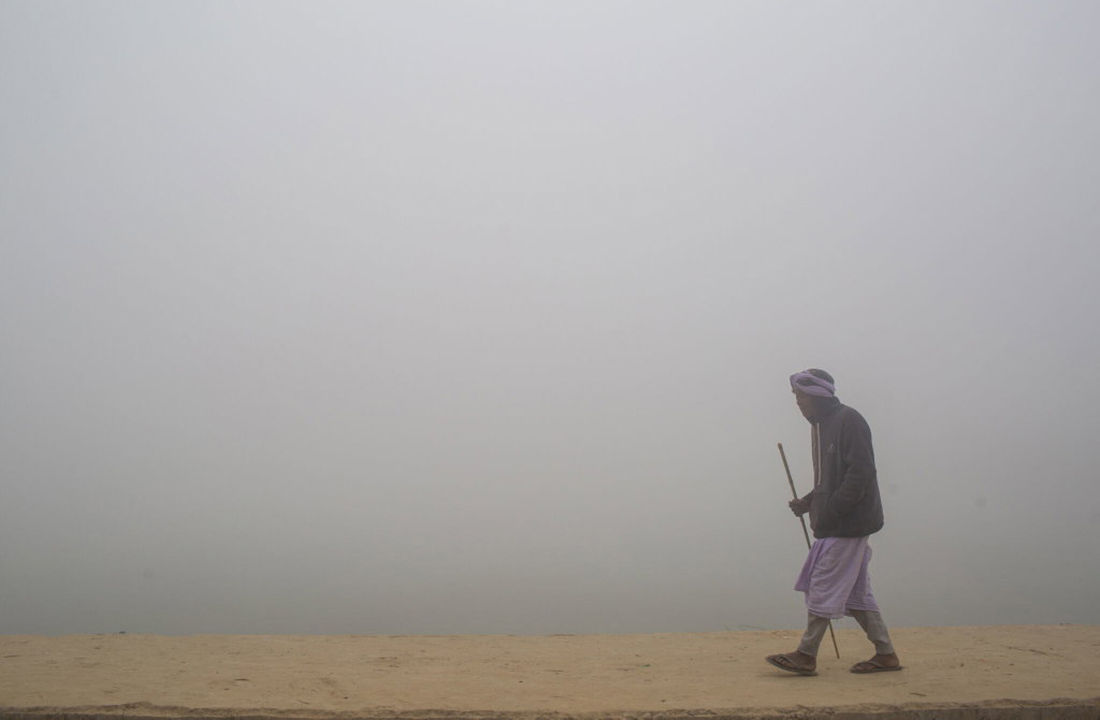
With the help of communication specialists at Climate Outreach, the Climate Visuals image library was created. The image accompanying this article comes from that platform. Smog episodes, those dense blankets of smoke and haze that affect major urban centres around the world, significantly degrade air quality, with serious consequences for the health of more vulnerable people.
A local concept
The definition of what constitutes a heat wave obviously varies depending on the context and location. During the webinar, reporters from Kenya and Pakistan pointed out that heat waves do not carry the same meaning in countries where high temperatures are a permanent reality.
Galey notes that extreme heat harms local economies through lost productivity, failed crops and increased health risks for agricultural workers, among other impacts.
Goodell stresses the importance of linking heat wave risk to vulnerability and geography. “On a hot day, everybody walks on the shady side of the street, right?” he says. But there are many places around the world where shade is scarce, the electrical grid is unreliable and safe drinking water is not readily available.
In his book, Goodell cites the example of Jacobabad, a city in Sindh province in central Pakistan with a population of about 200,000. Daytime temperatures there often exceed 50 degrees. In 2019, it was described as the hottest city on the planet.
In June 2021, The Telegraph published Hotter than the human body can handle: Pakistan city broils in world’s highest temperatures, a report by journalist Ben Farmer and photographer Saiyna Bashir documenting the impact of the heat on the people living in Jacobabad. Bashir is originally from Karachi.
A standard thermometer measures dry-bulb temperature, but scientists have developed the wet-bulb thermometer to measure the combined effects of heat and humidity. When the wet-bulb temperature reaches 35 °C, conditions become lethal. That threshold has been recorded on several occasions in this Pakistani community.
Once that level is reached, sweating is no longer enough to regulate the body’s internal temperature. Within a few hours, an exposed person can die from cardiac arrest, even if they were previously in good health.