
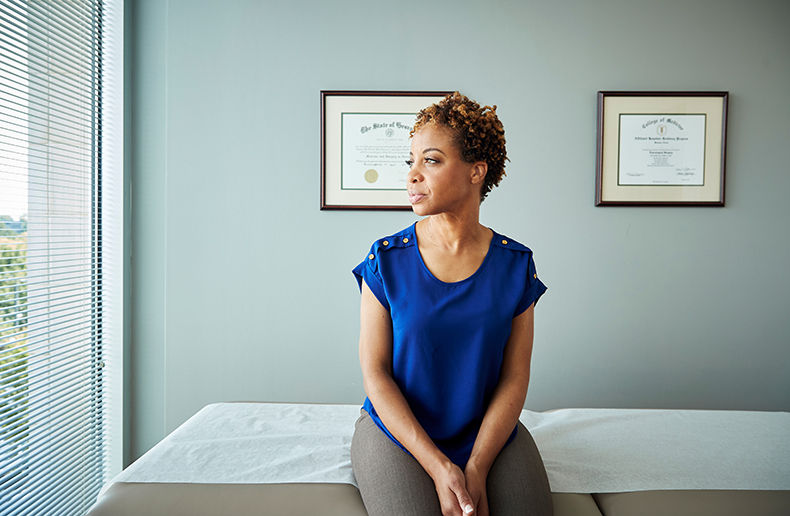
Nearly two out of three women report having difficulty addressing certain health issues with their doctor, according to a new study from Blue Cross. However, 53 per cent of women have experienced a chronic illness, while 71 per cent report having to repeatedly reconstruct their health histories with each appointment.
The study, Positive healthcare experiences don’t tell the full story, notes that there is a considerable amount of invisible work women need to do to navigate, coordinate and advocate for care when there is a medical need. The study is based off a survey conducted on 2045 respondents.

In an interview with Insurance Portal, Pacific Blue Cross president and CEO, Sarah Hoffman says the research reveals the unique opportunity that insurers have to play a positive role, beyond simply being claims reimbursement engines.
“What we really wanted to understand with this was not just access to care but more the experience of care,” she says. “We’re hoping that overall, the study helps with conversations about what helps people feel heard and supported and confident when engaging with their health care providers. We hope it helps to support Canadians communicate their symptoms, advocate for themselves and navigate the health care system.”
The findings
If 64 per cent of women report that they’ve struggled raising certain health concerns with their physicians, the number of survey respondents jumps notably to 81 per cent among Gen Z respondents – those between 18 and 30 years of age. Likewise, 73 per cent of Millennials between ages 31 and 45 similarly reported a reluctance to discuss certain concerns with their doctors.
"Embarrassment is the #1 reason women over 30 are holding back from their doctors, Blue Cross notes in its report. For those under 30, they fear dismissal or judgement." The fear of judgment, the fact that their concern might turn out to be “normal,” as well as the limited time allotted to each appointment are often mentioned when respondents are asked why they held back from raising certain concerns.
The survey also looks at the support different cohorts feel from their physicians.
“Among women who felt they needed to prove themselves to be taken seriously, many reported adapting how they approach medical appointments – including researching medical information, repeatedly describing or justifying symptoms, bringing written notes or documentation, tracking symptom timelines, making repeat visits and emphasizing how symptoms impact their daily lives,” Blue Cross writes in a press release announcing the study. “These findings suggest women are changing how they communicate to improve their chances of being heard during appointments.”
The insurance opportunity
Although the study was commissioned to hopefully connect all who touch both health care and insurance (the public, health providers, employers, policymakers), insurers are also encouraged to use the information to support clients on their respective health care journeys.
“Support is not just a soft measure, it’s really impacting how people engage with their care providers,” Hoffman says. “When people feel supported, they will communicate more openly, they’re going to approach their appointments differently.” She adds that the support clients receive before they visit a physician can also help with the feeling of needing to prove themselves.
“I think it provides insight into what opportunities could look like, moving beyond just being a claim reimbursement engine and really becoming partners in the health care system,” she adds.
Access to preventative care
The services which could be provided here can include helping Canadians navigate more effectively through the system, giving access to preventative care and support for chronic conditions.
“The study does suggest that Canadians want to feel more connected and they want the overall healthcare journey to feel like less of a burden to navigate, especially for women who are managing invisible labour everywhere in their lives, also in their healthcare journeys and quite often in their family members’ health, as well,” Hoffman states. “I think helping women be informed is really important.”
She notes that providing women with language and information they can use in their visits with care providers is another way insurers can help – insurers can play a role by providing additional support in the form of education.
“Finding ways to continue to invest in the research for women’s health is incredibly important,” she adds. “We’re making sure that we’re arming women with the tools they need.”